The intentions to document this information are long standing in that they go back some two decades to the early/mid 1990’s, just a few years before the subject of this site, James Kitchener Heath passed away.

As is the case in so many families in which a generation experienced war and all its traumas, certain aspects of service are known, but all too often the details are sketchy and disjointed. Add into this mix the passage of time and the result is invariably a collection of stories and fragments of memories accompanied by a handful of fragile and faded documents (if you are lucky) that represent the sum of information relating to the most extraordinary period in a soldier’s life. This was certainly the case in our family..... and it’s not much to go on.

In February 1995, my Father and I struggled to put together a potted service history to be read by the cleric presiding over my Grandfather’s funeral. At this point I decided to take steps to fill in some of the gaps as best I could.... sadly now without the benefit of first hand testimony.

A well known turn of phrase, ‘written on the back of a fag packet’ is defined by the Collins on-Line dictionary as something ‘composed or formed quickly and without detailed analysis or research’. As far as first hand source material for this history is concerned, no better a description could be made. The details gleaned from my Grandfather in brief (and often emotional) discussions in the 1990’s are summarised as a list of place names written in an old man’s shaky handwriting on the back of a standard envelope! (this will feature later). On the upside, a standard envelope is approximately twice the size of a cigarette packet, which immediately doubles the amount of information to work with!

By my own admission, this site is a little self-indulgent, being of primary interest to myself, my mother, my children and a handful of relatives still living in Staffordshire. In addition, it may be that the information presented here will be read by others outside of the family who have a passing interest in military or family history.

I would welcome any comments/suggestions or dare I say it relevant information to contact me.

adrianandrews@myyahoo.com

Monday, 25 August 2014

59 (Staffordshire) Division Deployment for Operation Charnwood

From the excellent MorssWeb site:

http://59div.morssweb.com/?frontpage

59 Division Deployment

LEFT
Obj: la Bijude, Epron
Opp: 1st Btn, SS PG Regt 25
RIGHT
Obj: Galmanche, St. Contest, Mâlon
Opp: 2nd Btn, SS PG Regt 25
176 Infantry Brigade
  • 7 Royal Norfolk
  • 7 South Staffordshire
  • 6 North Staffordshire
under command:
  • A Company, 7 RNF (machine gun)
  • 271 Anti-tank Battery
  • 248 Anti-tank Battery (1 troop)
support:
  • 13/18 Hussars (27 Armoured Brigade)
  • 116 Field Regiment RA
  • 257 Field Company RE
197 Infantry Brigade
  • 1/7 Royal Warwickshire
  • 2/5 Lancashire Fusiliers
  • 5 East Lancashire
under commmand:
  • 2/6 South Staffordshire (ex 177 Brigade)
  • C Company, 7 RNF (machine gun)
  • 298 Anti-tank Battery
  • 248 Anti-tank Battery
support:
  • 1 East Riding Yeomanry (27 Armoured Brigade)
  • 270 Anti-tank Battery
  • 110 Field Regiment RA
  • 510 Field Company RE
RESERVE (Cambes-en-Plaine)Notes
177 Infantry Brigade
  • 5 South Staffordshire
  • 1/6 South Staffordshire
under command:
  • 269 Anti-tank Battery
  • 61 Field Regiment RA
  • B Company, 7 RNF (machine gun)
In support of 59 Division for Operation Charnwood:
  • 27 Armoured Brigade (less one regiment)
  • flails (22 Dragoons) and crocodiles (141RAC), 79 Armoured Division
  • 5 ARE (less two squadrons)
  • 248 SP (M10) Battery, 62 Anti-tank Regiment

Operation Charnwood in Context

Priest self-propelled gun passes a Humber scout car of 79th Armoured Division, during Operation 'Charnwood', the attack on Caen, 8 July 1944 © IWM (B 6657).

'Operation Charnwood' was one of a series of actions that together made up I Corp's dogged attempts to take the city of Caen.

The ancient capital of the Normandy region was considered to be critical to the success of the Battle for Normandy. Caen was a D-Day objective for the British 3rd Infantry Division, but congestion at the beachheads on the 6th June leading to delays in moving off the beaches and the absence of the full complement of divisional armour meant that it was an understrength 3rd Infantry Division that assaulted the city. Timely reinforcement by the 12th SS Panzer Division Hitlerjungend caused the attack to falter on the outskirts of the city.

The early capture of Caen was of great strategic importance to the progress of 'Operation Overlord' since with the city in Allied hands, Caen would serve as a staging post for the advance to Falaise and then further east to Argentan and on towards the Touques river. The city and its surrounding areas would also provide airbases from which air support could be provided to the left flank of the US First Army as it advanced inland on the Cotentin Penninsula to the west.

With Caen still under German control after D-Day, there followed a series of operations intended deliver the city into  the hands of British and Canadian forces.

'Operation Perch' (7th June)
A pincer action intended to encircle the city with I Corps to the east, attacking from South of the Orne river and XXX Corps attacking across a front to the west. The eastern assault was halted by determined resistance from the 21st Panzer Division, whilst the western advance was checked at Tilly-sur-Seulles by the Panzer-Lehr Division. Tilly-sur-Seulles eventually fell to the XXX Corps on 19th June.

'Operation Martlet' (25th June)
A prelude to 'Operation Epsom' intended to secure the right flank of the VIII Corps.

'Operation Epsom' (26th June)
An VIII Corps action to the west of the city from Rauray in the west to Carpiquet in the direction of Caen. The objective was to gain control of the high ground at Bretteville-suer-Laize, once again with the intended outcome of an encirclement of the city. This action was opposed and halted by 9th SS Panzer Division Frundsberg of the II SS Panzer Corps.

'Operation Mitten' (27th June)
An 8th Infantry Brigade of the 3rd Infantry Division operation intended to capture the strongholds of Chateau la Londe and Chateau le Landel to the north of Caen. The objectives were secured on the morning of 28th June after heavy fighting which earned the area the grim epithet of 'the bloodiest square mile in Normandy'. The delay in achieving its objectives resulted in the cancellation of a planned Canadian action codenamed 'Operation Aberlour' which was to target the strongholds that 'Charnwood' attacked some days later.

'Operation Windsor' (4th July)
The 8th Canadian Infantry Brigade of the 3rd Canadian Infantry Division attacked the village of Carpiquet and Carpiquet airfield on the western outskirts of Caen. The village was taken on 4th July, but the airfield still remained in German possession. With a change in command of the German forces in the west, Generalfeldmarschall von Rundstedt, who favoured redeployment of the main German defences to positions opposing the US First Army, was replaced by Generalfeldmarschall von Kluge and the defence of Caen was once again the German priority.

With knowledge of the change within the German High Command, Montgomery opted for a frontal assault to the north of the city. The orders for 'Operation Charnwood' were issued on the 5th July 1944.

Map detailing the environs of Caen and the June and July operations that made up the Battle of Caen.

On the Eve Of Battle

Now concentrated, the Division then had two days (that is until 3rd July) to settle in. The exception to this was 177 Brigade (of which the 5th Battalion South Staffords formed a part, Grandfather included). Under the command of 1st Corps from 1st July, the 177 Brigade were to relieve the hard pressed 3rd Division, which had been the first British formation to hit ‘Sword’ beach on 6th June.

On 31st June the men of 177 Infantry Brigade moved up to the front line for the first time.

The 1/6th Battalion took over the line from the Royal Ulster Rifles at Cambes, a large village approximately four miles to the north of the besieged city of Caen.

The 2/6th Battalion moved to an orchard just south of the village of Anisy to the north of Cambes.

The 5th Battalion moved to the area of Galamanche slightly to the east of Cambes.

The movement of thousands of troops and tons of transport over the previous three weeks of a Normandy summer had resulted in the formation of a thick layer of dust across the terrain. This presented a risk as rising dust clouds gave away any troop movements in daylight. Dust allowed German observers to direct their artillery fire down onto the heads of formations on the move. Consequently, 177 Brigade were shelled as they moved into position, but on this occasion casualties were few.

A Humber scout car passes a sign warning of the dangers of raising dust, 12 July 1944 © IWM (B 7018)
http://www.iwm.org.uk/collections/item/object/205202160

The action in which my Grandfather was about to participate was codenamed ‘Operation Charnwood’

Portrait Of The Soldier As A Young Man


In all the time that I knew my Grandparents, this portrait of my Grandfather in his dress tunic adorned the living room wall. Later, after they died, this photograph was reunited with two similar portraits of my Grandmother and of my mother Margaret and uncle James. The photograph was hand tinted at this time. It is notable that my Grandfather appears rather swollen in the face in this picture and the story went that at the time of the sitting he was suffereing from excruciating toothache!

Saturday, 12 July 2014

The Waiting Ends – The 59 (Staffordshire) Division Sail

On 17th June, the long anticipated orders came through for the 59th to proceed to the marshalling areas ahead of embarkation. The advance parties of the Division departed on the same day, with the man body of men moving of on the following day, 18th June, destination Newhaven in East Sussex. The exception to this transit to the Sussex coast was the 2/6th South Staffords who accompanied the divisional transport to Tilbury Docks on the Essex stretch of the Thames.

Further frustration was felt within the Division when poor weather conditions resulted in the troops kicking their heels in the marshalling areas for another full week.

Immediately ahead of embarkation, the morale of the Division was lifted by receipt of the following stirring words in a message from their colonel, Major-General Comings.

Speech delivered to units of 59 (Staffordshire) Division on the eve of departure to the Normandy beaches.
Click on the image to enlarge.

Eventually, the Division sailed on 25th June, meaning that, as mentioned in an earlier post, ‘D-Day’ for my Grandfather and his brothers-in-arms was in fact 26th June 1944.

Such was the compression of the transport timetable as a consequence of the bad conditions that the advance parties, intended to receive the Division in Normandy, only arrived 24 hours ahead of the main body of troops and transport.

On 26th the weather was still poor, but it proved to be an uneventful crossing for my Grandfather who was with ‘A’ Company of the 5th South Staffords. The same cannot be said for his battalion comrades of ‘C’ and ‘D’ companies whose landing craft developed a fault and consequently drifted into a minefield. A helpful destroyer of the Royal Navy came to their aid and gave them safe-passage through a clear channel to the beach.

The 2/6th Battalion transport (including Battalion H.Q.) likewise did not have such an easy time of it as bad weather kept them off the beaches for several days before they were able to land. A rough ordeal for these Midland men with limited experience of the high seas!

Some sources state that the 59th Division landed on the British/Canadian ‘Juno’ beach, however, another detailed account of the South Staffordshire Regiment’s active service* clearly describes a landing on the eastern extreme of the British ‘Gold’ beach with the ‘tiny seaside villages of Arromanches and Tracy-sur-Mer on the right'.

View over 'Gold' Beach (looking East)
10th May 2014

A landing at Arromanches seems most likely, at least for the 5th Battalion and is consistent with my Grandfather’s envelope ‘chronology’ that states Arromanches as the first location after D-Day.

The village of Arramanches (looking West from the headland over 'Gold' Beach)
10th May 2014

Marker on the Arromanches observation platform

The fact that the Mulberry harbour at Arromanches was up and running by 26th June (or at least Mulberry B was, Mulberry A having been badly damaged in a storm on 19th June) would also suggest to me that this would have been the logical landing location for a follow up formation such as the 59th.


Remaining fragments of the Mulberry artificial harbour
10th May 2014

Panorama of the Mulberry artificial harbour from the radar station (now observation platform above Arromanches
(excuse the noise, it was very windy up there!)

An aerial oblique photograph of the Mulberry Harbour off Arromanches. Artificial harbours were constructed along the beach shortly after D-Day so that armoured vehicles and heavy guns could be landed (© IWM (BU 1024))
http://www.iwm.org.uk/collections/item/object/205021912

However, again from the ‘Your Men In Battle’ record, reference is made to the fact that as a consequence of minimal opposition by the enemy, water-proofed tanks (presumably DD or Duplex-drive tanks) were able to wait for low tide in order to drive up onto the beach in very shallow water rather than in the anticipated deep water of a high tide. This suggests that some, if not all, of the transport landed directly from boat to beach rather than via the pontoon roadways that connected floating quays with the beach at Arromanches (centre of the photograph above).

Sherman DD (Duplex Drive) amphibious tank with waterproof float screens. When in the water the float screen was raised and the rear propellers came into operation © IWM (MH 3660).
http://www.iwm.org.uk/collections/item/object/205124984

DD Sherman tank (with canvas curtain now raised) takes to the water.

Any clarification as to exactly how the Division landed in Normandy would be gratefully received!

As indicated above, in stark contrast to the hellish reception of sand, steel and blood endured by the troops who landed on 6th, all was quiet and the Germans were no longer in evidence. The indicators of war were limited to ‘a broken-backed landing craft’ on the beach and the roar of Allied aircraft overhead.

Inland the situation was very different indeed, a fact well understood by the South Staffords as the Division concentrated in the area between Bayeux and Cruelly. Given the delays, this concentration was achieved very rapidly and by 1st July, the Division was in one place, less elements of the Royal Army Service Corps (R.A.S.C.).


Saturday, 5 July 2014

Jim Heath’s Personal Record from 1940 to June 1944


The previous posts have shed some light on the movements of 59 (Staffordshire) Division, 177 Infantry Brigade and 5th Battalion South Staffordshire Regiment and the training that they undertook, firstly with the role of home defence and later in preparation for the invasion of Continental Europe that had to happen at some point in the future.

With the exception of the enlistment documents and his transfer to Lichfield I.T.C. at the point of embodiment in January 1940, all of this information has been gleaned from Peter Knight’s ‘The 59th Division Its War Story’. Other records that provide detail from this period are few and far between as there was no requirement for battalions to maintain war diaries until they commenced active service.
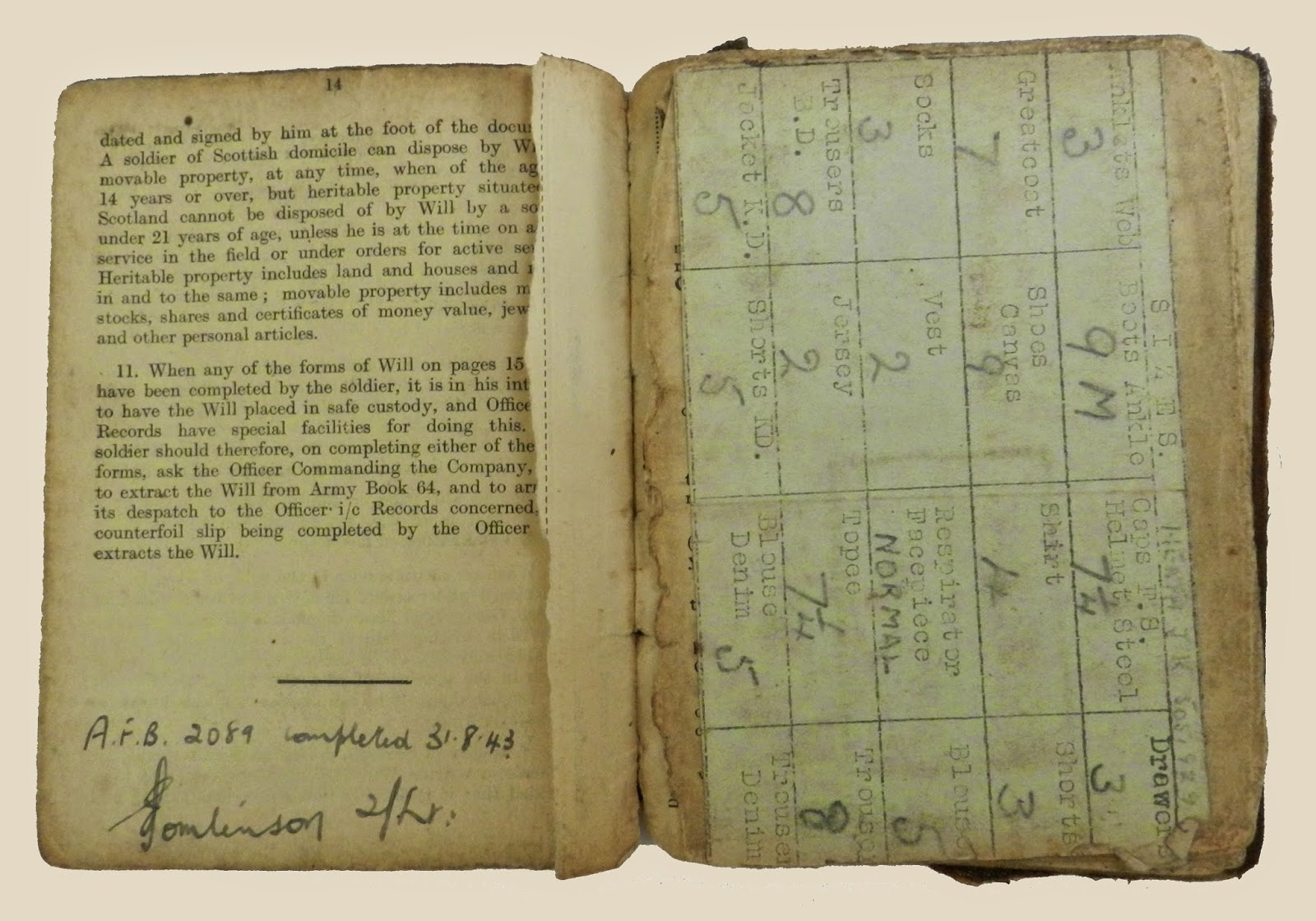
So here I will attempt to scrape together what little I have and this comes in the form of the information recorded in his ‘Soldiers  Service and Pay Book’ (Army Book 64), in which much of the day to day, often rather mundane, information was recorded including inoculations received, training completed, leave and uniform size requirements.

The inside page of Army Book 64 records his name, rank and number. There are four entries in his own hand, none dates and for each, the entry for Regiment (if infantry) has been carefully excised from the record with a blade, clearly as a security/intelligence measure in the event of a soldier being taken prisoner.


In the absence of dates, I cannot be sure of what these entries relate to with certainty, but I would assume that his time with the North Staffords, the South Staffords and the Royal Scots Fusiliers is represented. That would account for three of the four entries, one being a mystery since I do not assume that it would relate to his time in an administrator within No.12 Unit Displaced Persons Assembly Centre (D.P.A.C.S.) within the British Army of Liberation (B.L.A.) at the end of the war.

Then follows some basic personal/physical information. Note that again on the stamp, possible information of enemy intelligence value has been obscured.


Page 4 details ‘Particulars of Training’. Under ‘Courses and Schools Specialist Qualifications'. Showing result’. Here is recorded the following:

Courses and Schools Specialist Qualifications. Showing result
Date
Initials of Officer
D.M. Chamber *
Feb 1940
?
2” Mortar Qualified **
11.5.40 to 18.5.40
?
D.M. Test
Feb 1942
?
Asst Armourer’s Course
Qualified as Asst Armourer
19.5.43
?


*The use of the gas chamber to test if Service personnel could fit their respirators properly dates back to 1918. Servicemen fitted their respirators, entered the chamber and walked round for 5 minutes in an atmosphere of tear gas. After leaving the chamber, respirators were worn for a few more minutes to allow gas to dissipate from clothing. Special capsules of CAP, an early tear gas, were issued for this training. This routine was augmented in 1935. After going through the procedure to check respirators had been fitted properly, each man briefly re-entered the chamber without protection as a demonstration of the protection afforded by the respirator.

By 1941 all Service personnel went through this respirator test and unprotected exposure every three months. Personnel were also required to experience a nose gas, DM, so that they might be able to recognise the gas and appreciate its delayed action effects.

Personnel were exposed to DM for two minutes: no-one was required to experience DM more than once. These arrangements continued after World War II.

The requirement to experience DM ceased in 1963. CAP, or CN as it was also called, remained in use as a riot control agent until the late 1950s, when it was replaced by CS. By 1964 CS was being used instead of CAP in what became known as the "CS chamber" test. Every member of the Armed Services was required to undergo the test. The test continued through the 1980s, by which time most permanent military stations and training camps had a CS chamber.

**The 2" mortar was for use within infantry platoons. It was a short barreled (21 inch) weapon, effective over a 500 yard range, operated by teams of two (one guiding the direction of fire and one loading the shells. 

British 2" Mortar

Men of the Royal Scots Fusiliers firing a 2-inch mortar, Scotland, 27 August 1942 (© IWM (H 23477))
http://www.iwm.org.uk/collections/item/object/205198634

Later in the book under ‘Record of Specialist Employment Whilst Serving’, ‘Mortar Pl. 3”’ is detailed from March 1940. Under ‘Remarks and Initials of Officer’ are what could be initials, but equally could read ‘Fail’. Other employment is barely legible but one entry ‘25t’ could correspond to the responsibility for driving a 2.5 ton lorry. This I know he did as he mentioned this acquired skill frequently as one of his wartime achievements and the fact that it was the Army who taught him to drive.


One page of the ‘Record of Specialist Employment Whilst Serving’ section has been adapted to record periods of leave.

Date
Nature of Grant + Period
Whether Free Warrant Issued
Initials of Officer
18/3/41
28/4.4.41    Priv.
Yes
?
26/6/41
Privilege   26/6 – 2/7/41
Yes
?
7.10.41
Privilege   9 – 15.10.41
No
?
10.3.42
Privilege   12 – 27.5.42
Yes
?
30.9.42
- “ -            1 – 9.10.42
Yes
?
23.11.42
Compassionate 23/11 - 9/12/42
Yes
?
22.2.43
Priv. Leave 27/2/43 – 3/3/43
Yes
?
1.6.43
Priv. Leave 1 – 10.6.43
Yes
?
1 – 9.5/45
Priv. Leave B.L.A.
Yes
?

A couple of things are worthy of note from this record of leave, one relates to one period, shortly after the birth of his daughter Margaret Anne (my mother) where he had one of two brushes with the long arm of the military law. According to the family story, Margaret became ill at the age of about three months during which time he was absent without leave. Time wise this would tally with the period from 9th to 15th October 1941, but whether this relates to the ‘No’ recorded under the free warrant issue column I cannot say.
The last period of leave is significant as this week spans the period of formal surrender of the German Armies in Rheims and Berlin. This 8th May was to become known as V.E Day (Victory in Europe) and on this day Jim Heath was with the family in New Brighton, then a popular British seaside resort on the Wirral peninsula, Merseyside.


Another significant record in the book is the periodic medical classification. Of note here is the reclassification that was documented on 10th April 1945 from A1 to B6. This was the result of wounds sustained in the Nijmegen area on 7th April 1945. But that is some way of yet in this narrative.

Date
Category or Grade
Medical Examiner of Recruits, or Other Medical Authority
Initials of Medical Officer
19.3.40
A1

RL
20.7.43
A1
Category Confirmed
JKB
10.4.45
B6
MED. BOARD 8 xxxxxx
?
22.11.45
B6
DEMOBILISATION
RH

In terms of medical classification, from 1939 the letter designated the following service options:

A – Fit for general service at home and abroad,

B – unfit for general service abroad but fit for base or garrison service at home and abroad,

C – fit for home service only,

D – unfit for any form of military service.

In 1940, the classification system used by the British Army was further refined to relate the grade to the ability to perform service relevant activities such as marching, shooting and driving. I have noted in research reference to the classification through B to 5, but not to 6.


Vaccines and inoculations received follows (see above for the scan):

Vaccination

Date Vaccinated
Initials of Medical Officer
13.4.40
RL

Protective Inoculations

Nature of Vaccine, “T.A.B.”
Cholera, Plague etc.
Date
Initials of Medical Officer
TAB ½ cc TETTOX 1 cc
3.4.40
RL
TAB 1 cc
13.4.40
RL
TET
May/40
RL
TAB    xxxxxxx
24.3.41
HA
TET
1.10.41
HA
½ cc TAB. 1 cc TET
19/11/42
JKB
½ cc TAB. 1 cc TET
17.12.43
JKB
Typhus (3)
26.1.44
JKB
TAB .25 cc
31.8.44
JKB
Typhus. TAB .25 cc
11.2.45
JKB

T.A.B. = typhoid-paratyphoid A and B vaccine
TETTOX = tetanus toxoid vaccine

Next of Kin Now Living

Nearest degree of relationship
Names
Date
Latest known Address in full
Wife
June Heath
29.1.40
‘Shangrella’
Leylands Road
Burgess Hill
Sussex

‘Clovelly’
Western Road
Burgess Hill
Sussex

40 Albermarle Road
Cross Heath
Newcastle
Staffs
Children
James Kitchener Heath
Margaret Anne Heath


Next, details of the wardrobe, not very snappy admittedly.... but I would love to have seen him in a pith helmet (described below as a topee)!


And finally,

Soldier’s Name and Description on Attestation

Army Number                                5051929
Surname (in capitals)                       HEATH
Christian Names (in full)                  JAMES KITCHENER
Date of Birth                                   14-9-1914
Place of Birth                                  Parish --------------------
                                                       In or near the town of REDACTED
                                                       In the County of REDACTED
Trade on Enlistment                         Tile maker
Nationality of Father at birth             British
Nationality of Mother at birth            British
Religious Denomination                     Unitarian
Approved Society                             Prudential
Membership No
Enlisted at                                         REDACTED On 6-1-40
For the:-
*Regular Army                  *Supplementary Reserve
*Territorial Army              *Army Reserve Section D
*Strike out those inapplicable

For D of W years with the Colours and ___________ years in the Reserve.

Signature of Soldier ___________________________
Date                                                      29-1-40

(D of W meaning the duration of the war).


Sunday, 29 June 2014

The 59 (Staffordshire) Division Home Service (August 1939 to June 1944)

Here is a somewhat simplified summary of the movements of the 59 (Staffordshire) Division in the war years prior to their move to Normandy in 1944 (adapted from the original in 'The 59th Division It's War Story'.


Key to locations

1. Alton Towers (Staffordshire)
2. Liverpool (Merseyside)
3. Bromborough (Merseyside)
4. Cannock Chase (Staffordshire)
5. Various Locations (North Yorkshire And County Durham)
6. West Hartlepool & Seaton Carew (County Durham)
7. Whitby (North Yorkshire)
8. Alnwick (Northumberland)
9. Killyleagh (County Down)
10. Portadown (County Armagh)
11. Dungannon (County Tyrone)
12. Tenterden (Kent)
13. Northiam (East Sussex)
14. Margate (Kent)
15. Stammer Park, Brighton (East Sussex)
16. Seaford (East Sussex)
17. Newhaven (East Sussex)
18. Tilbury (Essex)
19. Juno & Gold Landing Beaches, Normandy