Some fantastic footage of 'Operation Charnwood' and the struggle to take control of Caen has been brought to my attention. The footage depicts both the Allies and the German formations fighting bitterly around the city. Having visited the area to the north of Caen where my Grandfather first saw action in the area of St. Contest-Galamanche, this footage features a very similar landscape to that which I walked across, the difference being I wasn't being shelled!
The intentions to document this information are long standing in that they go back some two decades to the early/mid 1990’s, just a few years before the subject of this site, James Kitchener Heath passed away.
As is the case in so many families in which a generation experienced war and all its traumas, certain aspects of service are known, but all too often the details are sketchy and disjointed. Add into this mix the passage of time and the result is invariably a collection of stories and fragments of memories accompanied by a handful of fragile and faded documents (if you are lucky) that represent the sum of information relating to the most extraordinary period in a soldier’s life. This was certainly the case in our family..... and it’s not much to go on.
In February 1995, my Father and I struggled to put together a potted service history to be read by the cleric presiding over my Grandfather’s funeral. At this point I decided to take steps to fill in some of the gaps as best I could.... sadly now without the benefit of first hand testimony.
A well known turn of phrase, ‘written on the back of a fag packet’ is defined by the Collins on-Line dictionary as something ‘composed or formed quickly and without detailed analysis or research’. As far as first hand source material for this history is concerned, no better a description could be made. The details gleaned from my Grandfather in brief (and often emotional) discussions in the 1990’s are summarised as a list of place names written in an old man’s shaky handwriting on the back of a standard envelope! (this will feature later). On the upside, a standard envelope is approximately twice the size of a cigarette packet, which immediately doubles the amount of information to work with!
By my own admission, this site is a little self-indulgent, being of primary interest to myself, my mother, my children and a handful of relatives still living in Staffordshire. In addition, it may be that the information presented here will be read by others outside of the family who have a passing interest in military or family history.
I would welcome any comments/suggestions or dare I say it relevant information to contact me.
Friday, 10 July 2015
Extraordinary Colour Footage of Operation Charnwood
Some fantastic footage of 'Operation Charnwood' and the struggle to take control of Caen has been brought to my attention. The footage depicts both the Allies and the German formations fighting bitterly around the city. Having visited the area to the north of Caen where my Grandfather first saw action in the area of St. Contest-Galamanche, this footage features a very similar landscape to that which I walked across, the difference being I wasn't being shelled!
Monday, 29 June 2015
A Scot From Stoke - With The Royal Scots Fusiliers (August 1944 to December 1945)
My Grandfather's military record shows that following the disbandment of 59 (Staffordshire) Division he was formally transferred to the 11th Battalion of the Royal Scots Fusiliers on 26th August 1944.
As I previously did whilst researching his time in the Staffordshire Regiments, my first point of contact was the Regimental Museum, now The Regimental Museum of the Royal Highland Fusiliers, located on Sauchiehall Street in the centre of Glasgow, The researchers there were extremely helpful and provided some excellent source material to get me started on this the next part of 'the fragmented history'.
Army Book 358, The Register Of Soldiers of the Royal Scots Fusiliers revealed that he was indeed a soldier of the regiment until the date of his release to the Reserve, recorded in the Register Of Soldiers as 5th March 1946 (a date reported elsewhere, his MOD record as 6th March 1946).
Sunday, 24 May 2015
The Falaise Pocket And The Demise of A German Army
Saturday, 7 March 2015
Disbandment – The End of 59 (Staffordshire) Division
Thursday, 5 March 2015
The Last Action of the 59th - 5th Battalion in Menil Vin and Rabodanges
Having secured Fresnay, the Battalion advanced to the river achieving a crossing on 16th August approximately two miles to the south of Thury Harcourt by way of a small ferry. Resistance coming from the town had largely been subdued over the previous few days as a result of an attack on the stronghold on by the 2nd Gloucestershire Regiment. With the crossing effected by the 5th South Staffords to the south and the news that the 2/5th Lancashire Fusiliers had reached Le Grand Donnay some four miles south east of Thury Harcourt the defenders of the town feared being cut off from the main body of the retreat. Upon crossing the only opposition encountered by the 5th came from a few snipers in the rear guard, who were put to flight by returning fire. Those that did not flee surrendered and were taken prisoner.
The next strongpoint objective had been identified as the small settlements of Menil Hermai and Rabodanges, also on the Orne approximately twenty miles to the south east of Thury Harcourt. 'A' and 'B' Companies under Major Grey and Major Smallwood respectively were to capture Menil Hermei village in an attack supported by tank and artillery. However, upon advancing on the objective, after the artillery ceased firing, the village was found to be clear of the enemy. The Germans were replaced by French villagers who filled the main street to celebrate in such numbers that the tanks were prevented from moving forward.
'A' and 'B' Companies were ordered to hold Menil Hermei against a possible counterattack and to provide a secure base for 'C' and 'D' Companies who were to attack the village of Rabodanges and the nearby objective high ground of Point 206. 'C' Company (under Major Hall) and 'D' Company (under Major McIntyre) advanced along the Menil Hermei-Rabodanges road screened by carriers. When the leading carrier was destroyed after hitting a mine, this signaled the commencement of the German defensive response with heavy fire brought down upon the two Companies from every weapon available. Regardless, the attack Companies forged ahead and achieved contact with the enemy. Fighting raged for several hours before 'C' and 'D' Companies were ordered to consolidate the gains and dig in a short distance from Point 206.
The fighting had left the Companies short of ammunition such that a counterattack would have had grave consequences. It was the courageous actions of one Captain Graham Ellis, who with a pioneer platoon, cleared a path through mines whilst under heavy fire, that allowed desperately needed ammunition to be brought up the line. For this feat Captain Ellis was awarded the Military Cross. He was later killed in action. The anticipated counterattack never came, in part as a result of aggressive patrolling and heavy artillery fire brought down on the known German positions throughout the night.
It was on the 21st August after further artillery 'softening up' of the Point 206 objective that the high ground was taken . The Germans attempted to dislodge the 5th Battalion from Point 206 with heavy fire from their long range guns, but no counterattack was put in by the infantry.
In this way the last battle of the 59 (Staffordshire) Division concluded with the enemy encircled in the Falaise area and focused only on their efforts escape from the jaws of the 'Pocket' that the Allied armies had created.
Sunday, 15 February 2015
The South Staffordshire Regiments In The Orne Bridgehead
From the beginning of August, the tide was turning in Normandy as the ability of the German forces to oppose an enemy having almost complete control of the air and such an overwhelming superiority in equipment was nearing its end. Cracks started to appear in the German defences which ultimately opened up to the extent that the entire German 7th Army and the 5th Panzer Army (albeit much depleted in strength) became encircled by British, Canadian and U.S. forces and were annihilated in the infamous ‘Falaise Pocket’. However, at the beginning of the month this dramatic demise of the German forces in France was three weeks off and the 59th were faced with many more days of hard fighting yet.
In that first week of August, all the regiments of South Staffordshire were moved forward towards the Orne River in what were to be the final series of actions in which they fought as part of the 59 Division.
The prominent role in the advance to the western banks of the Orne and the subsequent formation and defence of the bridgehead was taken up by the 7th South Staffordshire Regiment of 176 Brigade. Orders were received late on the evening of 3rd August that the 7th were to launch an attack towards the Villers Bocage. In doing so the decision was taken to advance across country towards the village as the road was known to be heavily mined. In order to advance in this manner, specialised tanks were brought up which were capable of launching 40 lb T.N.T. charges that cleared the high hedges and banks of the bocage whilst armoured bulldozers cleared the debris to create passages through which the infantry could pass.
The infantry companies began the advance in the early morning of 4th August. From gathered intelligence it was anticipated that resistance would be very light as the enemy had withdrawn from the area, but in doing so had made good use of mines and booby traps laid and set with the intention of impeding the British progress as much as possible.
In the shattered village of Villers Bocage the only inhabitants encountered by the advancing units were discovered to be German wounded and the nursing staff that were tending to them.
By 4 pm the main road from Tilly had been cleared of mines, but the forward movement resulted in gridlock for the mass of transport attempting to move through the area. With the enemy nowhere in sight, orders were passed down to the forward companies of 7th Battalion to advance towards and to occupy a series of prominent positions approximately 10 miles distant from the River Orne.
The fact that contact with the enemy had been lost was a cause for concern within the British command. In order to confirm the enemy’s withdrawal, the divisional ‘Recce’ units headed out in the pre-dawn of 5th August in the direction of the river. Their intelligence reports did indeed confirm that nothing of the enemy was in evidence to the west of the river, other than signs of a hasty retreat, and that the Germans had crossed over the Orne.
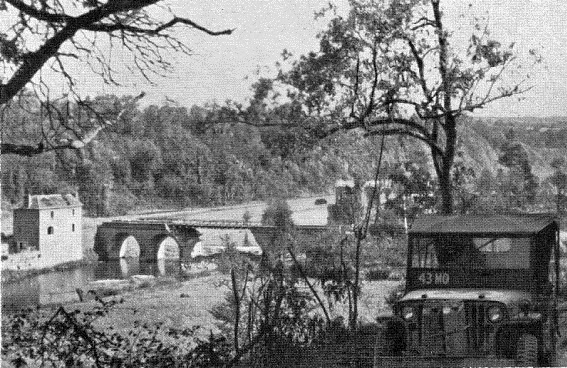
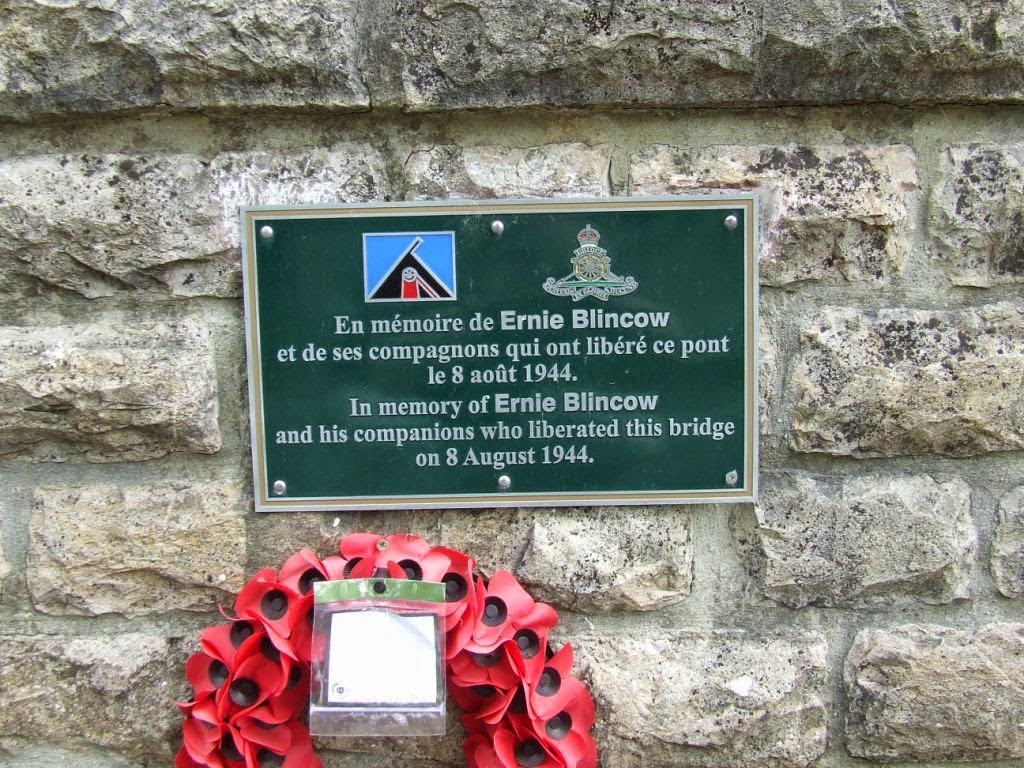
By 4 pm that day the forward formations reached the high ground that overlooked the Orne valley and they were able to establish that the stone bridge at La Bas, the only crossing point, had been blown up by the Germans once they had crossed over.
Along roads that ran parallel to those taken by 7th Battalion, but shifted approximately three miles to the south, the formations of 177 Brigade approached and reached the river. By 7 pm the Brigade had concentrated. From the concentration area, the battalions of 177 had gained a good vantage point from which they were able to observe the hurried preparation of new German defensive positions.
The topography of the River Orne was a critical consideration to the Division as they 176 planned the crossing, The river itself runs its course in this area through a deep and narrow valley, the western banks of which are very steep and thickly covered with undergrowth. The river is approximately 50 feet wide and fordable in several places. In contrast the eastern slopes are shallower and the land that runs up from the banks of the river to the dense Grimbosq Forest features orchards, small farms and villages. The forest was approximately two miles wide and one mile deep. The existence of this wooded land directly opposite the planned bridgehead would later offer cover for enemy troop concentrations from which attacks on the bridgehead positions could be launched.
Prior to the crossing, night patrols had identified a couple of crossing points for the troops. The 'War Story' account described how one of them was established, 'in one area the height of the banks was measured by lowering a six-foot officer by his heels from the edge of the bank until he touched water below'. 176 Brigade now had a place to cross where the men would be able to wade across to the opposite bank which a ‘recce’ by Lieutenant Ball, accompanied by a Canadian officer, had established was only lightly defended. However, this would be without supporting armour which due to the steep banks could only cross in the area of La Bas and with the bridge destroyed it would be for the Royal Engineers to position and secure a Bailey bridge next to the blown stone bridge as quickly as possible.
With the South Staffordshire forces congregated across the western banks of the Orne the infantry units dug in whilst small and medium calibre guns were moved up with all possible speed in order to support the soldiers as they made the crossing.
With the 7th Battalion in position on the west bank of the river, the sister Battalions of the regiment, the 1/6th, 2/6th and the 5th) moved forward on the 3rd August and concentrated around St Agneau le Malherbe some 8 miles to the west of the Orne.
Saturday, 14 February 2015
59 (Staffordshire) Division Advance Towards The Orne
The 59 Division advance started with a 197 Brigade action in the Juvigny area, approximately three miles to the north of Noyers. Tanks of the 7th Royal Tank Regiment were in support. The attack progressed well and thorough patrols were maintained to ensure that enemy withdrawals did not go unnoticed. A German counter attack in the same area was repelled by the 7th Royal Warwicks.
By 1st August the 197 Bridage sector had quietened down to the extent that the 2/5th Lancashire Fusiliers were withdrawn, but an increase in enemy activity rapidly brought them back into the line. Fierce local fighting continued and in three days of combat the toll on 197 Brigade was high at 19 officers and 383 other ranks killed, wounded or missing. However, the German armour was held in the area well away from the U.S. advance further to the west.
From 3rd August intelligence reports indicated significant enemy withdrawals were taking place from the XII Corps front and the formations of 59 Division pressed the advance towards the Orne. 197 Brigade were in action once again, advancing to take the high ground to the immediate north east of Villers-Bocage. Resistance was light, but rear guard pockets of Germans along with anti-personnel and anti-tank mines continued to hamper the progress of the British soldiers. By 3pm on 4th August, one company of the 2/5th Lancashire Fusiliers entered the ruins of Villers-Bocage, where the R.A.F. had completed the destruction started by the artillery. 176 Brigade passed through the village.
Meanwhile, 177 Brigade finally occupied Noyers which had eluded them over the previous weeks and taken such a heavy toll across its ranks. By night, 176 Brigade controlled the high ground five miles to the south east of Villers-Bocage. 59 Recce Regiment were to be found in Landes, three miles to the east of the village and 177 were positioned on the road between Villers-Bocage and Noyers. 197 were now in reserve.
At this point, the 59th suffered a blow when 31 Tank Brigade were replaced by 34 Tank Brigade under the divisional command. Thus a close tank crew/infantry understanding that had developed in the previous two weeks of fighting was lost. This loss of learnt close cooperation would result in an increase in casualty figures within the Division in the coming days.
49 (West Riding) Division Memorial, Fontenay-le-Pesnel
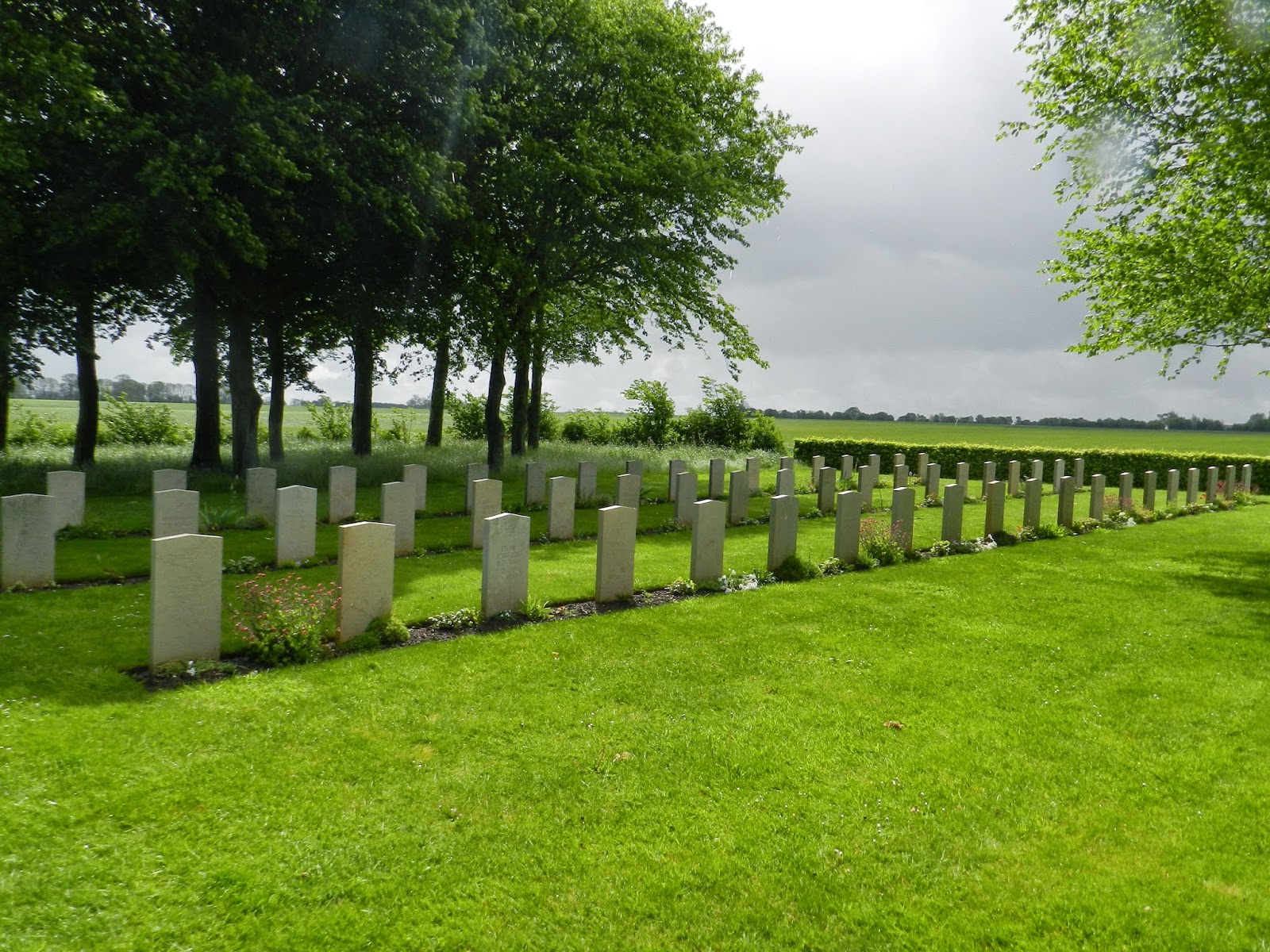
The Divisional Cemetery At Fontenay-le-Pesnel
It was under a louring sky in May 2014 that my friend and I paid a visit to the Divisional Cemetery at Fontenay-le-Pesnel. Located 16 kilometers to the west of Caen, the cemetery is the final resting place of 460 Commonwealth soldiers of which 452 are identified.
After the Battle Of Noyers
As described earlier, the prize of the village of Noyers was not delivered into British hands during the fighting of 16th to 19th July, but in terms of the overriding aim of Operation Pomegranate it was considered to be a successful action. The Battle had, as intended, drawn the enemy away from the Caen sector and the U.S. forces then looking to break out at the base of the Cotentin peninsula.
Throughout the Battle of Noyers the men continued to learn combat skills that were to be critical to their survival such as the importance of close collaboration between infantry and the supporting tank crews. Nevertheless, the casualty list was long and in all 59 Division recorded 1250 men killed, wounded or missing, a tally that mirrored the toll in the Battle for Caen earlier in the month.
The remainder of July was taken up with intense patrolling in the area. The full complement of the three infantry brigades of 59 Division in the front line was achieved when 197 Brigade moved up to relieve 70 Infantry Brigade of the 49th (West Riding) Division in the area of Juvigny-Vendes on 21st July. The brigades of 59 Division each had two battalions in the line with one in reserve.
Under brigade command, squadrons of the 59th Recce Regiment moved into the line in order to allow the infantry to move into rest areas company by company. On 23rd July, 33 Armoured Brigade left the divisional area as 59 Division came under the command of XII Corps and 31 Tank Brigade came under the command of 59 Division.
Thursday, 29 January 2015
'Oh I Do Like To Be Beside The Seaside!' - Redcar Summer 1941
Sunday, 18 January 2015
Another Perspective on the Battle For Noyers - Colonel William Dewhurst Douglas 11th Battalion Royal Scots Fusiliers
Such was the scale of the Overlord operation and so numerous were the daily acts of individual heroism in the Normandy campaign that the deeds of some formations are not widely documented. Sadly, this is the case for the 59th (Staffordshire) Division. Aside from the 'It's War Story' and the 'Your Men In Battle' books, both now long out of print, references to the 59th are few and far between in the public domain.
However, the excellent archive held by the Imperial War Museum contains an interview of approximately two hours duration with one Colonel Douglas, an officer who served with the 11th Battalion Royal Scots Fusiliers in North West Europe between 1944 and 1945.
A formation within the 49 (West Riding) Division, the 11th Battalion Royal Scots Fusiliers fought alongside the 5th Battalion South Staffordshires during Operation Pomegranate. Indeed after the fighting in Normandy concluded the remnants of the 59th Division units were transferred to other Divisions. In this way my Grandfather was incorporated in the 11th Battalion Royal Scots Fusiliers for the remainder of the war. Reference is made to this transfer of the Staffords in Colonel Douglas' account below.
In this extract, Colonel Douglas describes his observations as the men of the 59th Division assaulted the station area of Noyers.
'It was around this time that I began patrolling. I think that by the and of the campaign I'd probably done more patrols than any other Lieutenant in the entire British Army. Anyway, I did my first recce patrol down a slope towards Noyers station where the enemy was supposed to be preparing a new position down at the far end of the slope to hold up our next advance and we had to find out what they were doing'.
'Which station?'
'Noyer, N-O-Y-E-R station, it may have an 'S' on it on some maps. Well we went down this slope, a very long one, about a mile, a mile and a half long this slope. Not a blade of grass on it, not a bush, nothing. It was a wide open, ex-cultivated field actually. We saw the enemy, they were wiring and they were digging trenches and you could hear them muttering and you could see the odd flash of a cigarette behind someones hand so we crawled back before daylight and reported all this and a great, tremendous bombardment was put on them that morning which apparently did them no good at all.
About this time, 'cos not a great deal was happening where we were, all we had to do was hold this ridge in readiness for the 59th Staffordshire Division, who were to come up through us with armour support and go down and capture the Noyers position. And we had time to wander about on top of this position and what impressed me at the time was how marvellous the German dug-outs were, I mean some of them were twenty or thirty feet into the ground. They were lined with sheets, they had tables, chairs, lamps, mind you they'd had four years to get them ready I suppose. It was just a great shame that they were all facing the wrong way because otherwise it would have been marvellous for us to go into.
Eventually, the poor old 59th Division set off in a daylight attack down the slope. And I wasn't a regular soldier at the time and as a mere platoon commander I had no great military knowledge I suppose, but even to me it seemed madness to send an entire Division down a slope that was a mile and a half long in broad daylight, in spite of all the shells and mortars and things going down hill. And it was hardly surprising the next day when we discovered that it had had so many casualties that the 59th Division was disbanded, they just couldn't replace all their losses.
We got one or two of their chaps, they were either North Staffs or South Staffs, they had quite incomprehensible accents but they were the most marvellous diggers that I'd ever come across. They were coal miners of course and they were brilliant at digging slit trenches. They could dig three trenches when you were half way down into your own, so in that respect they were a very great asset.'
Saturday, 17 January 2015
59th Division and Operation Pomegranate
The battle opened up at 0530 hours on the morning of 16th July, so called 'H’ hour. Passing over the start lines, the 5th East Lancashires of 197 Brigade reached their first objective east of the village of Vendes and by 0800 had captured part of the village despite a determined defence encountered from the outset of the attack. Here the 5th East Lancashires were pinned down and prevented from further advance when by 2.30 in the afternoon an effective infantry counter-attack with tank support overran one company on the right and forced the withdrawal of the remaining forces of the occupying battalion back to their start line.
To the east, the 1/6th and the 5th South Staffords moved on their allotted objectives. The 1/6th captured Brettevillette little over an hour after starting out and by 0845 hours troops of the Battalion had advanced as far as Quediville. In likewise manner, the 5th South Staffords captured the orchards to the west of Granville sur Odon and by noon Les Nouillons was in their hands. Thus it was that by this time, all of the 177 Brigade's objectives had been achieved, but at a high price. Resistance was heavy and effective, the objective village remains were thickly mined with both anti-tank and anti-personnel mines. Furthermore, two thirds of the tanks in support of the 1/6th assault ‘brewed up’, to use the parlance of the tank men of at the time, in a British minefield that remained in place, despite assurances that clearance would have been completed in advance of the attack. The confusion of the fighting was compounded when many troops became disorientated and misdirected in the heavy morning mist . By 1330 hours tanks equipped with mine clearing flails began to enter the minefields at Quediville. This marked the close of Phase I of the attack.
Phase II was launched in the early evening with a 2/6th Battalion advance of the village of Noyers Bocage (Hereafter referred to as Noyers) and three quarters of an hour later the 6th North Staffords (under the command of 177 Brigade for this action) assaulted Haul des Forges. The 6th succeeded in taking their objective, but in the face of heavy opposition, after initially penetrating some way into the village, were forced to withdraw to the area around Noyers railway satation. On this day 177 Brigade took a total of 369 German prisoners, all soldiers of the 277 Infanterie Division.
During the remainder of the 16th July, on the hard pressed right, another assault on the Phase I objective was launched, this time by the 2/5th Lancashire Fusiliers, but their efforts were thwarted by the heavy and accurate mortar fire laid down by the defenders and little was achieved.
The following two days were focused on the concerted efforts of the 177 Infantry Brigade to take Noyers. A dawn attack on the village by the 1/6th and the 5th South Staffords fell someway short of reaching the station and the men were pinned down until 13.30 hours when the order came through to withdraw and reorganise. A further attack by the 5th was launched from the north east of the village but was repelled just inside the outskirts. A 1/6th South Staffords advance from Bretteville in the direction of Bordel failed under heavy defensive fire. After dark all troops were withdrawn in order to ‘soften up’ the village defences with shell and mortar fire.
The 17th also saw the 1/7th Royal Warwicks of the 197 Brigade with support from the 1st Norfolk Yeomanry achieve success in assaulting the phase I objectives. To drive home this success and to strengthen the 197 Brigade front, 176 Brigade moved on Bordel , but without great success. At this time H.Q. 1/7th Royal Warwickshire was hit by two large bombs which resulted in high casualty numbers.
Attempts to subdue Noyers were renewed at 10 am on the morning of 18th once again with the 1/6th and 5th South Staffords advancing on the fortified village. Despite strong, albeit depleted, armoured support, this action as well as another assault in the afternoon was unsuccessful and the forces of the 59th Division once again withdrew by evening to allow shells and mortar to resume their attempts to subdue the resilient defenders of Noyers.
Once again on the right, by nightfall, the 1/7th Royal Warwicks had occupied Ferme de Guiberon and reports came in from the 49th Infantry Division of German withdrawals across the front. The 7th South Staffords of 176 Brigade attacked, captured and held the area from Bordel up to la Seneviére.
After three days of heavy fighting the process of relieving the exhausted, battle weary troops in the line began. During the night of 18th July, 176 Infantry Brigade relieved 197 Brigade, thus allowing it to move into reserve positions. Elsewhere on the right, the 7th Royal Norfolks relieved the 1/7th Royal Warwicks.
On the 19th, the 49th Division occupied Vendes, after the enemy had withdrawn from the village. Plans for a renewed assault on Noyers, after 177 Brigade dawn patrols confirmed that the village was still held by the Germans, came to nothing.
At 1250 hours on the 19th July, the Corps Commander passed down orders to cease any further attempts to take Noyers and subsequent activities in the following days were restricted to aggressive patrolling across the front.
More detailed information on the fighting in which the soldiers of the South Staffordshire regiments were engaged is given a later post.
Wednesday, 14 January 2015
Operation Pomegranate - The Allies
Sunday, 7 September 2014
The Bombing Of Caen - 7th July 1944
The opening of 'Operation Charnwood' was preceded on the night of 7th July by the first involvement of Bomber Command in the Normandy campaign. In a tragic, and still much debated, episode in the Overlord story much of the ancient city of Caen was obliterated from the air.
The carpet bombing of the medieval city is to this day a highly controversial action on the part of the Allies. The strategic advantage gained by the bombing of the northern districts of Caen is questionable, given the resulting level of destruction and the high numbers of civilian casualties.
Between 21.50 and 22.30 hours on the evening of the 7th, a force of four-engined, heavy bombers totaling 467 Halifax's and Lancaster's flew over the north of the city. A combined payload of 2,560 tons of high explosive, incendiary and delayed-action bombs were dropped on the northern limits.
Flying at 2,500 metres, the intention was to complete bomb runs within a rectangular area measuring 4,000 yards by 1,500 yards. The target area was largely dictated by the insistence of Air Chief Marshall Sir Arthur Harris (perhaps now better known to history as 'Bomber Harris') that a 6,000 yard safety margin be in place from the position of the forward British and Canadian troops and the northern extremity of the target area. This was to be achieved through use of a system that had been successful in the raids over Berlin, whereby a Master Bomber marked the target area and then observed the progress and positioning of the subsequent attack from a higher altitude. From such a vantage point the Master Bomber could revisions and adjustments could be communicated to the Deputy Master Bomber below as the situation demanded to ensure the accuracy of bombing throughout the raid.
http://www.iwm.org.uk/collections/item/object/205211589
The need for such a system was to control a phenomenon in which over time bomb loads tended to to be dropped earlier with the result that the inflicted damage would creep backwards from the intended target area. This was caused both by the fact that target markers became obscured in the inevitable flame and smoke of the raid and as a result of the urge for aircrews, in the face of heavy flack put up by a city's defences, to minimise the time spent over the target before turning for the home run.
In the Caen raid of 7th July, the consequences would have been catastrophic had such a 'creep back' occurred and brought payloads down on the Allied formations massed to the north of the city. Thus it was that the bombing had a very limited impact on the enemy troop and armour concentrations facing the 59th Division as the target area was well to the rear of the Germans in an area in which few military installations were located.
In the event the raid had some impact upon the men of a detachment of the 16th Luftwaffe Field Division. Additionally, the 12th SS Panzer Division Hitlerjugend lost a mortar section and two tanks to the action.
Not easily measurable in terms of military advantage gained, but to the men of the 59th, who in a few short hours were to experience combat for the first time, the psychological and morale boosting effect of watching the RAF giving the 'hun' a pasting would have been immense.
On the other hand the casualties inflicted on the French civilian population was high. The Centre de Recherche d'Histoire Quantitative within the University of Caen estimated that 350 civilians lost their lives in the raid of the night of the 7th and in the fighting that ensued in the city on the following day. This figure is high when one considers that three quarters of Caen's peacetime population had been evacuated from the city at this point in time.
A less emotive consequence of the raid was the fact that by reducing the northern fringes of the city to rubble, the Allies created a cityscape that was easy to defend effectively by the German units that emerged from the deep defences within the city. Moreover, the level of destruction impeded movement into the city, slowing progress and reducing the penetration of the Allied forces into Caen on the tail of the German withdrawal across the River Orne.
It comes as no surprise that my Grandfather talked of this night as he would not as yet experienced anything in war even remotely as powerful and dramatic as the destruction of Caen from the air. During the raid, he would have been approximately 6 miles north of the city
http://www.iwm.org.uk/collections/item/object/205206008


.jpg)
.jpg)