The intentions to document this information are long standing in that they go back some two decades to the early/mid 1990’s, just a few years before the subject of this site, James Kitchener Heath passed away.

As is the case in so many families in which a generation experienced war and all its traumas, certain aspects of service are known, but all too often the details are sketchy and disjointed. Add into this mix the passage of time and the result is invariably a collection of stories and fragments of memories accompanied by a handful of fragile and faded documents (if you are lucky) that represent the sum of information relating to the most extraordinary period in a soldier’s life. This was certainly the case in our family..... and it’s not much to go on.

In February 1995, my Father and I struggled to put together a potted service history to be read by the cleric presiding over my Grandfather’s funeral. At this point I decided to take steps to fill in some of the gaps as best I could.... sadly now without the benefit of first hand testimony.

A well known turn of phrase, ‘written on the back of a fag packet’ is defined by the Collins on-Line dictionary as something ‘composed or formed quickly and without detailed analysis or research’. As far as first hand source material for this history is concerned, no better a description could be made. The details gleaned from my Grandfather in brief (and often emotional) discussions in the 1990’s are summarised as a list of place names written in an old man’s shaky handwriting on the back of a standard envelope! (this will feature later). On the upside, a standard envelope is approximately twice the size of a cigarette packet, which immediately doubles the amount of information to work with!

By my own admission, this site is a little self-indulgent, being of primary interest to myself, my mother, my children and a handful of relatives still living in Staffordshire. In addition, it may be that the information presented here will be read by others outside of the family who have a passing interest in military or family history.

I would welcome any comments/suggestions or dare I say it relevant information to contact me.

adrianandrews@myyahoo.com

Saturday, 28 February 2015

177 Brigade and The Struggle For The Ridges Overlooking The Orne

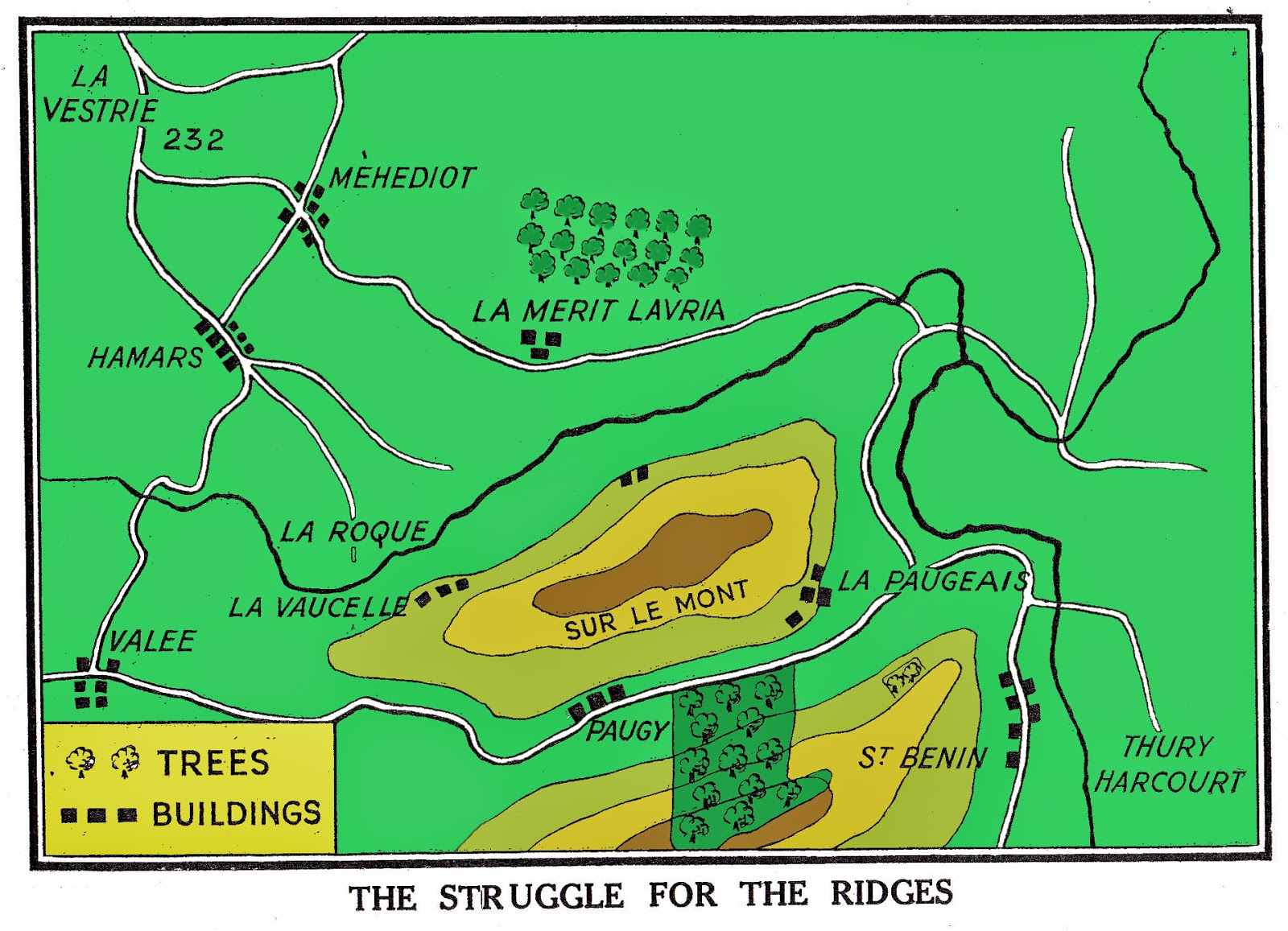
Whilst their comrades in the 7th Battalion were being hard pressed in the Grimbosq bridgehead the other South Staffordshire battalions of 177 Brigade did not remain static. Between the Brigade and the river lay a series of ridges of increasing height before the land dropped away into the Orne valley. Each of these ridges overlooked its lower predecessor.

The ‘Your Men In Battle’ account describes the forward movement of 1/6th Battalion on the 5th August after a short period located in St Agneau le Malherbe, with the men of ‘C’ Company (which formed the advance guard) moving up towards the river on a fleet of bicycles shielded by a screen of carriers. The task of ‘C’ Company was to take the high ground of La Vestrie and Point 232 located approximately to the south east of their position in the direction of the Orne. Although these heights were unoccupied by the Germans, such was the nature of the undulating terrain that were the enemy to be in control of the ridge opposite La Vestrie and Point 232 every movement made by the Battalion would be observed which would spell disaster.


Facing 1/6th ‘C’ Company was a feature called Sur le Mont, the first of major the ridges. Additionally, another ridge of high ground lay between Point 232 and Sur le Mont with the features of La Rocque and La Merit Lavria to the right and left respectively. These latter two objectives would have to be secured quickly.

‘B’ Company were tasked to take the objective of La Rocque whilst it was the job of ‘D’ Company to capture La Merit Lavria. Critically, no tank support was available for the attacks which were to go in at 1400 hours.

The ‘B’ Company assault was pressed home successfully and although they were shelled, few casualties resulted. ‘D’ Company had a harder time of it and the fact that most of their advance was made under the eyes of the Germans meant that the defensive mortar fire was deadly accurate. Upon approaching the objective of La Merit Lavria the Company separated, with two platoons moving to the right and the other platoon along with Battalion H.Q. moving to the left. The fighting was heavy and news coming back out of the line was sparse, other than messages received to say that the men were under heavy long range machine gun fire. ‘A’ Company under the command of Major Geoffrey Ball were requested to come to the assistance of ‘D’ Company but they were unable to do so, reporting back that they were ‘too tied up’. Artillery and tank support was called upon.

At 1700 hours a message came through from ‘D’ Company’s commander to state that one company and Battalion H.Q. had reached the objective and that the other two platoons were attempting to link up with H.Q. ‘A’ Company were ordered to attack the position at 2100 hours. At the point where the two parties of ‘D’ Company met up a shell exploded wounding two officers. Consequently, the command of ‘D’ Company was taken up by C.S.M. Balding.

The 9 pm assault by ‘A’ Company was successful and all units were able to dig in, assisted in doing so by the failing daylight. The Battalion was now holding ground facing, but under, Sur le Mont. The Germans knew the Battalion position and laid down heavy fire. In response, British guns returned fire threefold.

The next challenge for the Battalion was to take Sur le Mont itself. If successful this would leave one further ridge remaining before 177 Brigade would control the last high ground over the River Orne. To achieve this objective, ‘A’ Company were to attack a hamlet called Sous le Mont to the left whilst ‘B’ Company were to take the settlement of La Vaucelle on the right. Both companies were successful in achieving their objectives and the German units were in retreat. At this point, a patrol lead by one Lance Corporal Walker captured ten Germans, one of whom cooperated and directed the British Artillery guns on to the remaining German positions and this action was enough to persuade the enemy to withdraw. Thus the objective of Sous le Mont was delivered into Allied hands for a minimum of casualties.

In order to consolidate the Battalion gains, ‘C’ Company under the command of Lieutenant Ellison lead an assault, with tank support, on a position over the ridge called La Paugeais. The attack was successful and brought the 1/6th to within one mile of the river bank. In the wake of the attack, the Germans retreated further towards the St Benin ridge in full sight of the British thus making themselves an easy target.


Sur le Mont was taken. The Battalion now controlled the east to west orientated road that ran over the Orne, through Thury Harcourt across to Falaise. However, the prize of the final ridge over the river, St Benin, was still occupied by both British and German troops.

Sunday, 15 February 2015

The South Staffordshire Regiments In The Orne Bridgehead

Map indicating the positions of opposing forces in the Orne Bridgehead 6th to 9th August 1944
(with thanks to http://59div.morssweb.com/)

As previously observed by Colonel Douglas, the units of the 59th Division suffered very badly in their repeated attempts to capture the village of Noyers. However, at this point in the campaign it was necessary to maintain the offensive and to this end the South Staffordshire Regiments were destined to suffer even greater casualty numbers in the last three weeks of the Division’s existence.

From the beginning of August, the tide was turning in Normandy as the ability of the German forces to oppose an enemy having  almost complete control of the air and such an overwhelming superiority in equipment was nearing its end. Cracks started to appear in the German defences which ultimately opened up to the extent that the entire German 7th Army and the 5th Panzer Army (albeit much depleted in strength) became encircled by British, Canadian and U.S. forces and were annihilated in the infamous ‘Falaise Pocket’. However, at the beginning of the month this dramatic demise of the German forces in France was three weeks off and the 59th were faced with many more days of hard fighting yet.

In that first week of August, all the regiments of South Staffordshire were moved forward towards the Orne River in what were to be the final series of actions in which they fought as part of the 59 Division.

The prominent role in the advance to the western banks of the Orne and the subsequent formation and defence of the bridgehead was taken up by the 7th South Staffordshire Regiment of 176 Brigade. Orders were received late on the evening of 3rd August that the 7th were to launch an attack towards the Villers Bocage. In doing so the decision was taken to advance across country towards the village as the road was known to be heavily mined. In order to advance in this manner, specialised tanks were brought up which were capable of launching 40 lb T.N.T. charges that cleared the high hedges and banks of the bocage whilst armoured bulldozers cleared the debris to create passages through which the infantry could pass.

The infantry companies began the advance in the early morning of 4th August. From gathered intelligence it was anticipated that resistance would be very light as the enemy had withdrawn from the area, but in doing so had made good use of mines and booby traps laid and set with the intention of impeding the British progress as much as possible.

In the shattered village of Villers Bocage the only inhabitants encountered by the advancing units were discovered to be German wounded and the nursing staff that were tending to them.


By 4 pm the main road from Tilly had been cleared of mines, but the forward movement resulted in gridlock for the mass of transport attempting to move through the area. With the enemy nowhere in sight, orders were passed down to the forward companies of 7th Battalion to advance towards and to occupy a series of prominent positions approximately 10 miles distant from the River Orne.

The fact that contact with the enemy had been lost was a cause for concern within the British command. In order to confirm the enemy’s withdrawal, the divisional ‘Recce’ units headed out in the pre-dawn of 5th August in the direction of the river. Their intelligence reports did indeed confirm that nothing of the enemy was in evidence to the west of the river, other than signs of a hasty retreat, and that the Germans had crossed over the Orne.

By 4 pm that day the forward formations reached the high ground that overlooked the Orne valley and they were able to establish that the stone bridge at La Bas, the only crossing point, had been blown up by the Germans once they had crossed over.

Along roads that ran parallel to those taken by 7th Battalion, but shifted approximately three miles to the south, the formations of 177 Brigade approached and reached the river. By 7 pm the Brigade had concentrated. From the concentration area, the battalions of 177 had gained a good vantage point from which they were able to observe the hurried preparation of new German defensive positions.

The topography of the River Orne was a critical consideration to the Division as they 176 planned the crossing, The river itself runs its course in this area through a deep and narrow valley, the western banks of which are very steep and thickly covered with undergrowth. The river is approximately 50 feet wide and fordable in several places. In contrast the eastern slopes are shallower and the land that runs up from the banks of the river to the dense Grimbosq Forest features orchards, small farms and villages. The forest was approximately two miles wide and one mile deep. The existence of this wooded land directly opposite the planned bridgehead would later offer cover for enemy troop concentrations from which attacks on the bridgehead positions could be launched.

Prior to the crossing, night patrols had identified a couple of crossing points for the troops. The 'War Story' account described how one of them was established, 'in one area the height of the banks was measured by lowering a six-foot officer by his heels from the edge of the bank until he touched water below'. 176 Brigade now had a place to cross where the men would be able to wade across to the opposite bank which a ‘recce’ by Lieutenant Ball, accompanied by a Canadian officer, had established was only lightly defended. However, this would be without supporting armour which due to the steep banks could only cross in the area of La Bas and with the bridge destroyed it would be for the Royal Engineers to position and secure a Bailey bridge next to the blown stone bridge as quickly as possible.

With the South Staffordshire forces congregated across the western banks of the Orne the infantry units dug in whilst small and medium calibre guns were moved up with all possible speed in order to support the soldiers as they made the crossing.

With the 7th Battalion in position on the west bank of the river, the sister Battalions of the regiment, the 1/6th, 2/6th and the 5th) moved forward on the 3rd August and concentrated around St Agneau le Malherbe some 8 miles to the west of the Orne.


Orders received on the morning of 6th August determined that the 7th Battalion of 176 Brigade would be the first formation to cross over the river and it was their daunting task to establish the bridgehead on the opposite bank facing the villages of Grimbosq and Brieux. Their companion Battalions of 176 Brigade, the 6th North Staffords and the 7th Royal Norfolks would follow and expand the bridgehead. The bridgehead would have to be held against the inevitable German counter attacks by the men of 176 Brigade until a Bailey bridge could be brought up the line and set in place to allow further passage of infantry and armour into the bridgehead. Tank support was available, but the wooded slopes of the eastern bank put their effectiveness in support in doubt.

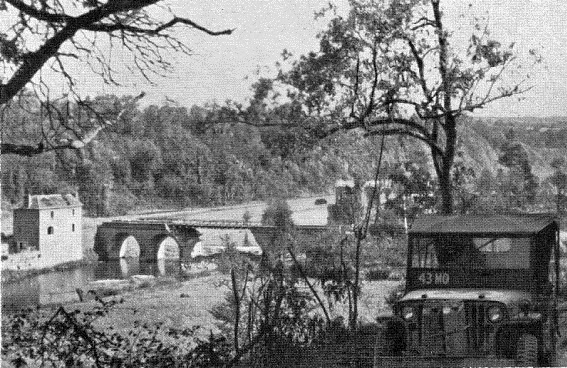
The bridge near La Bas viewed from the west bank of the Orne, 1944

The intensity of troop movements on the western banks of the river did not go unnoticed by the Germans who responded to the threat by laying down mortar fire on the opposite bank. However, for once the shelling had no significant detrimental impact upon the attackers.

The timing for the start of the assault for the units of the 7th South Staffordshires was set to be 2 o’clock in the afternoon and was heralded by a bombardment by 4.2 inch mortars. The crossing was achieved for few casualties, but the opposition stiffened once the opposite bank had been reached. Battalion objectives were in the village of Grimbosq, but in order to achieve them, the companies of the 7th were to form a rough square on the eastern side of the river with ‘B’ and ‘A’ Companies facing the German line with ‘C’ and ‘D’ Companies behind them. This position was attained by about 6 pm on 6th August.

Battalion H.Q., up to this point established in a chateau on the opposite bank, forded the river as darkness fell since their original position was drawing enemy fire and this resulted in a number of casualties. The new Battalion H.Q. position was established alongside ‘C’ Company between the river and the village of Grimbosq. At this point in the action, the German response to the crossing was very muted.

By now, the bridgehead had been successfully expanded with the companies of 7th Battalion established with the 6th North Staffords on their right flank and the 7th Royal Norfolks to their right. In the meantime, transporters were bringing up the Bailey bridge and supporting artillery were positioned on the opposite bank.

As dawn broke on the 7th the Germans had re-established a grip on the new situation and put in a savage counter attack. In the face of such heavy enemy shelling the casualty tally started to mount, but with the river to their immediate rear evacuation of the wounded to the casualty clearing stations behind the forward lines was near impossible.

In the environs of Grimbosq village ‘B’ Company lost their commanding officer, Major Gilbert, to a grenade whilst ‘C’ Company found themselves surrounded by the enemy on several occasions. Despite this determined defence the companies of the 7th held their positions.

Radio communication was limited but the attacking units did learn that the enemy had managed to establish a thin defensive line of infantry around the entire perimeter of the bridgehead. It was also understood that a significant element of an S.S. Panzer Division (KG Wünsche) were forming up in Grimbosq Forest immediately to the rear of the German front line.

Throughout the night the engineers had continued their endeavours to ensure that more equipment, ammunition and armour was able to cross the Orne. On the morning of 7th August the men of 176 Brigade were bolstered by the appearance of heavy 17-pounder self-propelled guns and tanks that had crossed the Bailey bridge under cover of darkness. Gunners manning the medium range artillery batteries sent salvos into Grimbosq Forest where enemy infantry formations were concentrating in anticipation of a counter attack. Efforts of the enemy to organise were further hampered by the diligence of observers from 1/6th, 2/6th and 5th Battalions (177 Brigade), then to the south of the bridgehead, who ensured that the artillery fire was brought down in the right places with maximum effect.

The blown bridge at Las Bas seen from a Bailey Bridge that enabled passage of armour into the bridgehead, 1944

The fighting continued and over time and 176 Brigade lost many men, killed or wounded. Those who remained uninjured were suffering from the effects of such a period of continuous combat. Whilst offensive actions were occurring across the front line, the heavy artillery barrage supporting an attack in the vicinity of Caen could be heard to the north from about 9 in the evening. It was hoped that this particular attack would offer some relief to those fighting in the Grimbosq bridgehead. At the same time the beleaguered Brigade received a boost to their morale when six rocket firing typhoon aircraft appeared and dealt a German tank concentration a devastating and deadly blow. As night fell heavy bombers flew over the positions held by the Staffords and flashes of high explosives dropped in support of a distant Canadian assault lit the night sky.
For a period of time the bridgehead battlefield became quieter, but as midnight approached the Germans renewed their efforts to dislodge the Brigade and drive them back across the Orne. Very lights announced concentrated mortar fire and the fighting continued throughout the night, all night, with some incursions into the Brigade positions that failed to lead to a German breakthrough. As dawn finally broke the soldiers took their first food on board for many hours, a meagre meal of cold sausage and army biscuit. The respite was short lived however as the enemy renewed the fight opening up with the feared Nebelwerfer, better known to the British as ‘moaning minnies’, a reflection of the characteristic howl of their incoming missiles. From the scant shelter of their slit trenches the men of 176 Brigade, somewhat revived by the hastily taken breakfast, continued to repulse the determined counterattacks. 

A Churchill tank of the 107th Regiment Royal Armoured Corps with the bridge visible in the background, 1944

The battle raged on throughout the daylight hours of the 8th August until the 7th South Staffords were relieved in the line. Their neighbours in the bridgehead, the 6th North Staffords and the 7th Royal Norfolks, likewise moved back to the battalion rest area behind the medium range guns.

In the fighting described above, the 7th Battalion were badly mauled to the extent that the action within the Orne bridgehead marked the end of the 7th Battalion, the surviving members of which were transferred to other units after a 48 hour period of rest. So heavy were their losses over the 7th and 8th August that there were insufficient reinforcements to preserve the Battalion as a fighting formation.

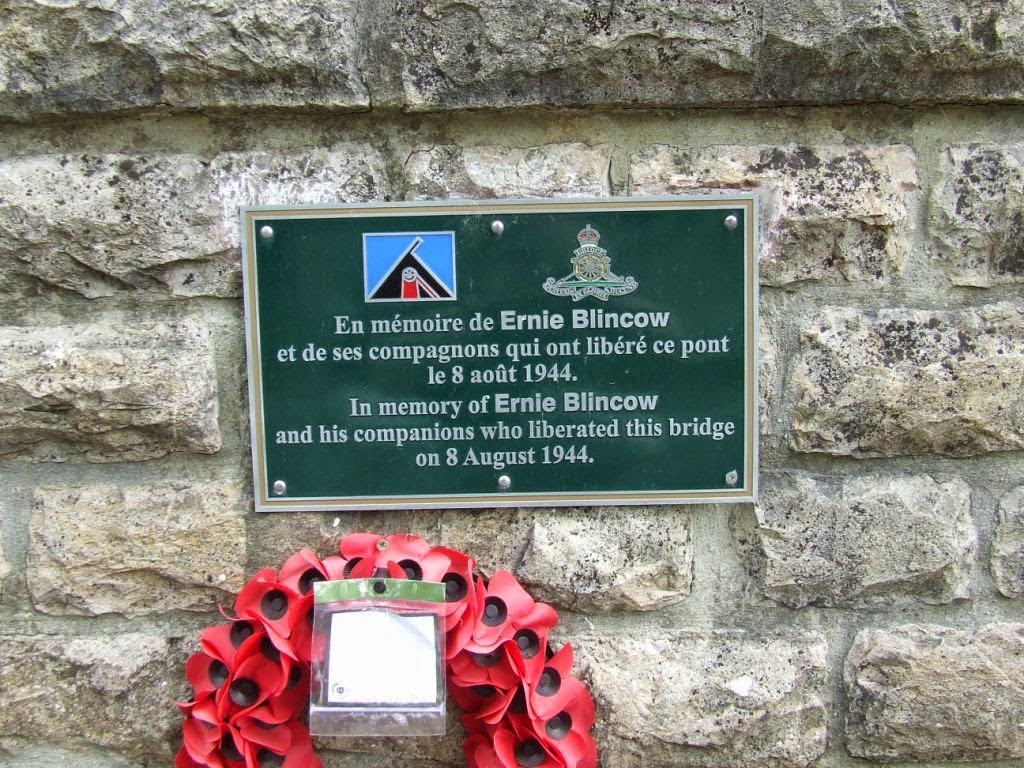
Memorial to the men of 59 (Staffordshire) Division and the Royal Artillery commemorating the liberation of the La Bas bridge over the River Orne on 8th August 1944

The Orne Bridgehead - The Germans

271 Infantry Division

Generalleutnant Paul Danhauser
Commanding Officer of the 271. Infanterie-Division

A Wehrmacht Division, the 271 Infantry Division (the 271. Infanterie-Division or 271. ID in German) was created as part of the 10th wave of mobilisation (10 Welle) on 22nd May 1940, but after completion of training it was subsequently disbanded in July as France signed an armistice with Germany.


On 17th November 1943 the 271. ID was reformed in the 22nd wave of mobilisation in the Netherlands from the division staff of the disbanded 137. Infanterie-Division. At the time of the D Day landings like the 276.ID and 277.ID, the 271st were located on the Mediterranean coast (stationed at Montpellier) watchful of possible Allied landings from the south,

271.ID was moved up into Normandy in early August. Considered to be poorly trained, the Division was destroyed as an effective fighting formation in the Falaise Pocket. Their Commanding Officer, Generalleutnant Paul Danhauser led the remnants of the Division out of the Pocket.

271.ID was reformed on 17 September 1944 as the 271. Volksgrenadier-Division from the partially formed 576. Volksgrenadier-Division. It saw action in Hungary and Czechoslovakia and surrendered to the Red Army in Mähren at the end of the war.

Kampfgruppe Wünsche

SS-Obersturmbannführer Max Wünsche
Commanding Officer of KG Wünsche

Kampfgruppe Wünsche (KG Wünsche) was an ad hoc combat formation of reserve units formed largely from the 12th SS Panzer Division. These formations typically carried the name of their Commanding Officer (Max Wünsche).

KG Wünsche was composed of the following units:


  • 3rd Company (Panthers) and 8th Company (Mark IVs), 12th SS Panzer Regiment (Hitlerjugend (HJ))
  • 2nd Company (Tigers), 101st SS Heavy Panzer Battalion
  • 1st and 3rd Battalions, 26th SS Panzer-Grenadier Regiment (HJ)
  • 3rd SS Panzer Artillery Battalion (HJ)

Saturday, 14 February 2015

59 (Staffordshire) Division Advance Towards The Orne

Soldiers of 59 (Staffordshire) Division advancing through Calvados

Consequent to Operation Pomegranate the German forces were concentrated across the 21st Army Group front opposite Caen and Villers-Bocage. The overall plan for 59 Infantry Division was, within XII Corps, to defeat the enemy formations in Villers-Bocage before advancing to the south west towards the River Orne to force a crossing if at all possible.

In this advance, 59 Division were in the centre of the line and were flanked by 50 Infantry Division to their right and 53 Infantry Division on their left. As 59 Division moved towards the Orne, XIII Corps maintained the pressure on the enemy with a southward attack towards Caumont and Mont Pincon (the highest point in the Calvados Department) in 'Operation Bluecoat'.

The 59 Division advance started with a 197 Brigade action in the Juvigny area, approximately three miles to the north of Noyers. Tanks of the 7th Royal Tank Regiment were in support. The attack progressed  well and thorough patrols were maintained to ensure that enemy withdrawals did not go unnoticed. A German counter attack in the same area was repelled by the 7th Royal Warwicks.

By 1st August the 197 Bridage sector had quietened down to the extent that the 2/5th Lancashire Fusiliers were withdrawn, but an increase in enemy activity rapidly brought them back into the line. Fierce local fighting continued and in three days of combat the toll on 197 Brigade was high at 19 officers and 383 other ranks killed, wounded or missing. However, the German armour was held in the area well away from the U.S. advance further to the west.

From 3rd August intelligence reports indicated significant enemy withdrawals were taking place from the XII Corps front and the formations of 59 Division pressed the advance towards the Orne. 197 Brigade were in action once again, advancing to take the high ground to the immediate north east of Villers-Bocage. Resistance was light, but rear guard pockets of Germans along with anti-personnel and anti-tank mines continued to hamper the progress of the British soldiers. By 3pm on 4th August, one company of the 2/5th Lancashire Fusiliers entered the ruins of Villers-Bocage, where the R.A.F. had completed the destruction started by the artillery. 176 Brigade passed through the village.

Scenes of devastation in Villers-Bogage after the fighting of July 1944

Meanwhile, 177 Brigade finally occupied Noyers which had eluded them over the previous weeks and taken such a heavy toll across its ranks. By night, 176 Brigade controlled the high ground five miles to the south east of Villers-Bocage. 59 Recce Regiment were to be found in Landes, three miles to the east of the village and 177 were positioned on the road between Villers-Bocage and Noyers. 197 were now in reserve.

At this point, the 59th suffered a blow when 31 Tank Brigade were replaced by 34 Tank Brigade under the divisional command. Thus a close tank crew/infantry understanding that had developed in the previous two weeks of fighting was lost. This loss of learnt close cooperation would result in an increase in casualty figures within the Division in the coming days.

49 (West Riding) Division Memorial, Fontenay-le-Pesnel

Memorial to the 49 (West Riding) Division
Fontenay-le-Pesnel

Just at the point of the turn off to the Fontenay-le-Pesnel War Cemetery stands an imposing monument to the men of the 49 (West Riding) Division, 'The Polar Bears' and the sacrifices they made in the fighting of 1944 and 1945,

Detail from the 49 (West Riding) Division monument

The walls of the monument carry separate memorials to the Brigades of the Division including the 147 Division to which Jim Heath was transferred, as part of 11th Battalion Royal Scots Fusiliers, on 29th August 1944 upon the disbandment of the 59 (Staffordshire) Division.

The plaque to 147 Division can be seen towards the end of this short piece of video footage of the monument.


The Divisional Cemetery At Fontenay-le-Pesnel


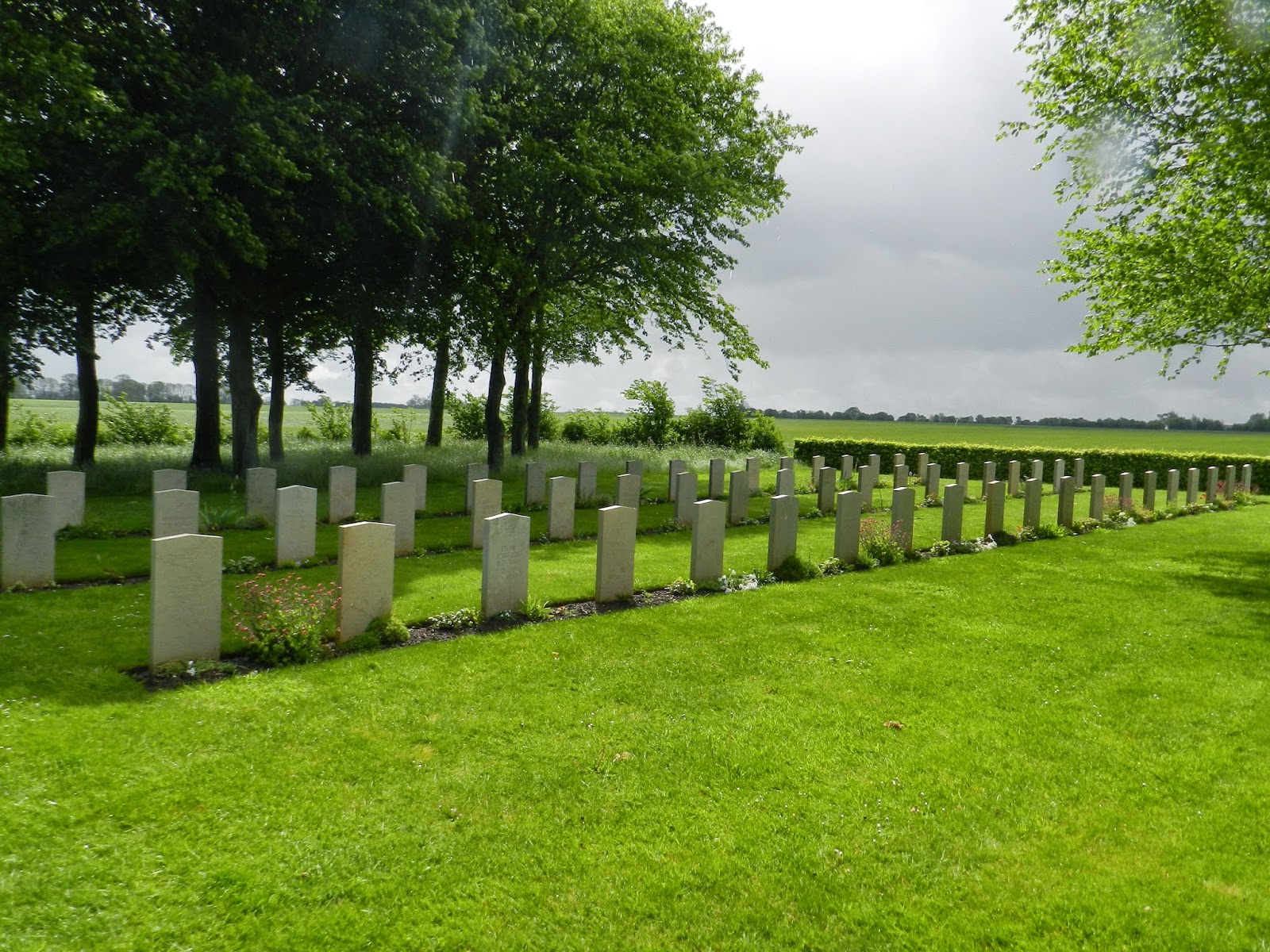
It was under a louring sky in May 2014 that my friend and I paid a visit to the Divisional Cemetery at Fontenay-le-Pesnel. Located 16 kilometers to the west of Caen, the cemetery is the final resting place of 460 Commonwealth soldiers of which 452 are identified.

Entrance to Fontenay-le-Pesnel War Cemetery 10th
10th May 2014

Immediately striking in the grounds of the cemetery is the profusion of headstones bearing the knot of the South Staffordshire Regiment. Of these, the majority carry the dates of the fighting during Operation Pomegranate, many of these men would have fallen in the repeated attempts to capture Noyers.


In addition, many men of the East Lancashire and the Royal Warwickshire Regiments as well as the Durham Light Infantry are commemorated in Fontenay-le-Pesnel War Cemetery.

It is near impossible to take in the details of each headstone, but one struck me as particularly sad. The headstone gave the details of a Private K.P. Mitton of the South Staffordshire Regiment who was killed on the 16th July 1944 at the age of 18. Towards the bottom of the headstone and you can see that his brother Flight Sergeant Harold Bertram of the R.A.F., killed in action on 11th February 1941, also lies here.


The cemetery also contains 59 German military graves.


The Cross of Sacrifice
Fontenay-le-Pesnel War Cemetery


After the Battle Of Noyers


As described earlier, the prize of the village of Noyers was not delivered into British hands during the fighting of 16th to 19th July, but in terms of the overriding aim of Operation Pomegranate it was considered to be a successful action. The Battle had, as intended, drawn the enemy away from the Caen sector and the U.S. forces then looking to break out at the base of the Cotentin peninsula.

Throughout the Battle of Noyers the men continued to learn combat skills that were to be critical to their survival such as the importance of close collaboration between infantry and the supporting tank crews. Nevertheless, the casualty list was long and in all 59 Division recorded 1250 men killed, wounded or missing, a tally that mirrored the toll in the Battle for Caen earlier in the month.

The remainder of July was taken up with intense patrolling in the area. The full complement of the  three infantry brigades of 59 Division in the front line was achieved when 197 Brigade moved up to relieve 70 Infantry Brigade of the 49th (West Riding) Division in the area of Juvigny-Vendes on 21st July. The brigades of 59 Division each had two battalions in the line with one in reserve.

Under brigade command, squadrons of the 59th Recce Regiment moved into the line in order to allow the infantry to move into rest areas company by company. On 23rd July, 33 Armoured Brigade left the divisional area as 59 Division came under the command of XII Corps and 31 Tank Brigade came under the command of 59 Division.