The intentions to document this information are long standing in that they go back some two decades to the early/mid 1990’s, just a few years before the subject of this site, James Kitchener Heath passed away.

As is the case in so many families in which a generation experienced war and all its traumas, certain aspects of service are known, but all too often the details are sketchy and disjointed. Add into this mix the passage of time and the result is invariably a collection of stories and fragments of memories accompanied by a handful of fragile and faded documents (if you are lucky) that represent the sum of information relating to the most extraordinary period in a soldier’s life. This was certainly the case in our family..... and it’s not much to go on.

In February 1995, my Father and I struggled to put together a potted service history to be read by the cleric presiding over my Grandfather’s funeral. At this point I decided to take steps to fill in some of the gaps as best I could.... sadly now without the benefit of first hand testimony.

A well known turn of phrase, ‘written on the back of a fag packet’ is defined by the Collins on-Line dictionary as something ‘composed or formed quickly and without detailed analysis or research’. As far as first hand source material for this history is concerned, no better a description could be made. The details gleaned from my Grandfather in brief (and often emotional) discussions in the 1990’s are summarised as a list of place names written in an old man’s shaky handwriting on the back of a standard envelope! (this will feature later). On the upside, a standard envelope is approximately twice the size of a cigarette packet, which immediately doubles the amount of information to work with!

By my own admission, this site is a little self-indulgent, being of primary interest to myself, my mother, my children and a handful of relatives still living in Staffordshire. In addition, it may be that the information presented here will be read by others outside of the family who have a passing interest in military or family history.

I would welcome any comments/suggestions or dare I say it relevant information to contact me.

adrianandrews@myyahoo.com

Showing posts with label The Polar Bear Association. Show all posts

Saturday, 15 July 2017

Presentation at Hill 112 Normandy 9th July 2017

Last weekend marked the 73rd anniversary of the battle to take Hill 112 to the South East of Caen. This modest area of high ground was viciously fought over as to command it meant control of the strategically vital surrounding area. Indeed Rommel described Hill 112 as the most important hill in Normandy. The task to take it was given to the men of the 43rd Wessex Division in an action code named 'Operation Jupiter' that was launched on the 9th/10th July 1944.

As with many significant sites across Battlefield Normandy, Hill 112 hosts many memorials, notably one to the 43rd (Wessex) Infantry Division.

43rd (Wessex) Infantry Division
Hill 112

Also of note is the Churchill tank at the site, a memorial to the many tank men who lost their lives in the actions.


Two weeks ago I met up with Dennis Dimond, Secretary of the 49th (West Riding) Division Association to pass over a number of copies of the book. He informed me that for one copy he had some very specific plans. He intended to travel to the location of Hill 112 to participate in the anniversary commemoration and to take the opportunity to make a donation from the Polar Bear Association funds to his counterpart in the Hill 112 Association for the maintenance of the Churchill tank pictured above.

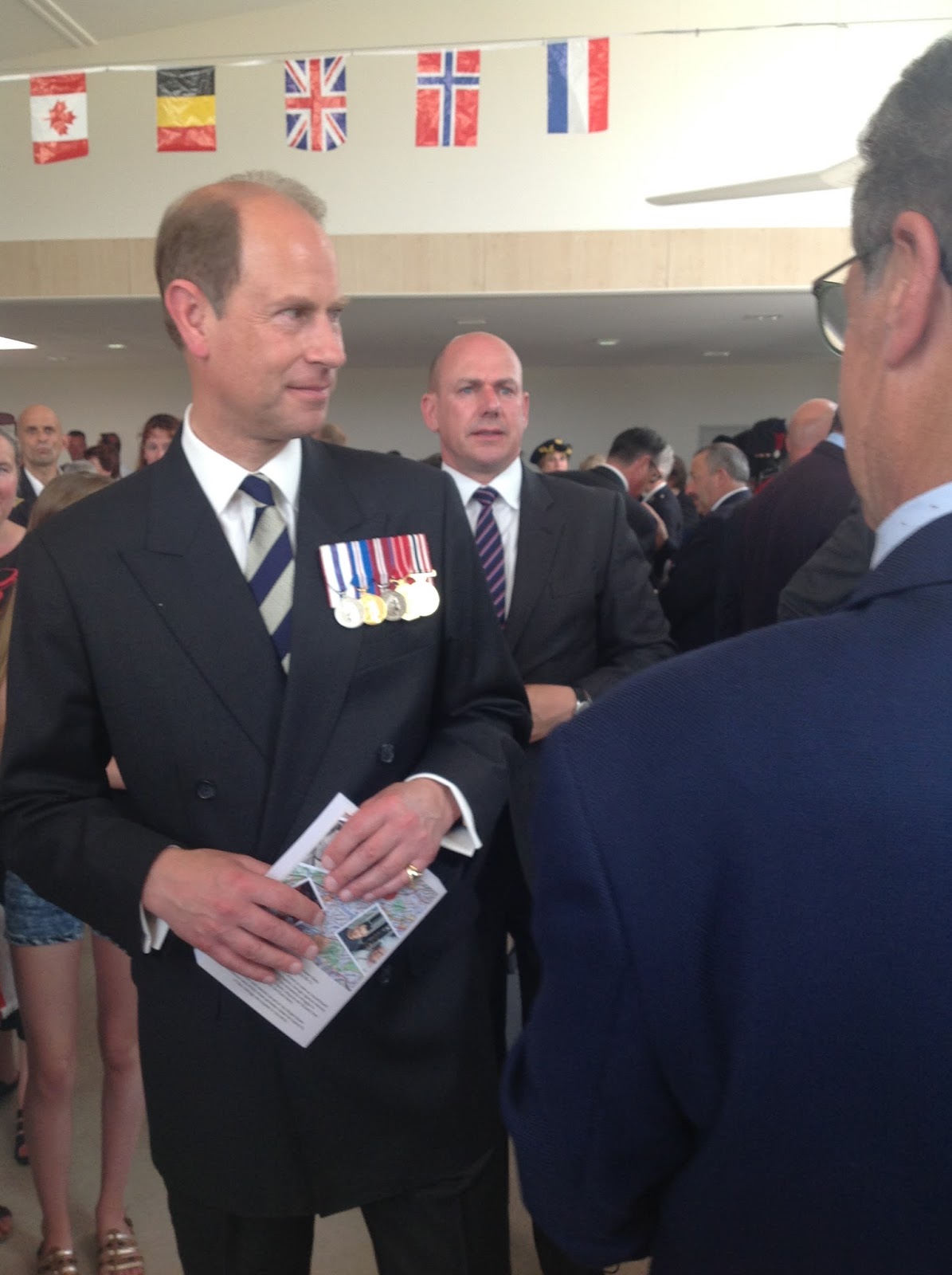
It so happened that Prince Edward (the Queen's youngest son) would also be in attendance. Edward has close associations through his position as the Earl of Wessex. Dennis's plan was to make a presentation of 'A Pithead Polar Bear' to Prince Edward or at the very least pass a copy on to one of his aides.

In the event he did a very good job and further more was able document the presentation on camera. Many thanks to Dennis and the other Polar Bear representatives who were in attendance last weekend.

Dennis Dimond greets HRH Prince Edward

Now down to business....


And up, up and away, with a aide clutching said the book.

So there you have it. That this book may be currently sitting on a royal bookshelf appeals to my sense of humour. I think that my Grandfather would be amused.

Saturday, 23 July 2016

Rock ‘n’ Roll, Rememberance and All That Jazz in The Lowlands Breda, Holland - 15th May 2015

In what was becoming something of an annual excursion Owen and I had planned another weekend on the continent with both military history and music on the itinerary.

Yet another old punk band was due to play at the ‘Eurorock Festival’ in Neerpelt in Belgium. The timing could not have been better since the ‘Fragmented Military History’ website had progressed considerably such that I had left Normandy and the 59th (Staffordshire) Division behind and was now immersed in the actions of the Polar Bears in Belgium and Holland.

The town of Breda was to be our base for the next three days from where we would drive in each and every direction in order to visit Turnhout, Wuustwezel, Roosendaal, Arnhem, Nijmegen, Bemmel, Haalderen and Walcheran. A check on the mileometer upon arriving back in London told us that we had clocked up no less than two thousand miles over the three days, mostly in the Netherlands (no mean feat in a country so small!).


Whilst we were planning to see a punk band (Killing Joke, were anyone to be remotely curious) our chosen base was this weekend hosting the annual Breda Jazz Festival. Now I fully appreciate that when it comes to musical taste it is definitely a case of ‘each to their own’. But without a doubt both Owen and I side with Johnny Rotten over Johnny Dankworth! So when a well-meaning waitress in the breakfast room on day two suggested that we were here for the jazz we were a little put out! Casting an eye over the finger poppin’ jazz aficionados of northern Europe that were at that time sharing the restaurant, it was clear to the two of us at least that a wide gulf existed between us and them. Nevertheless in a middle aged punk rock style we corrected her and complimented the chef on the quality of his scrambled eggs. How times have changed!

Caught unawares in a lift finger clicking and ‘extolling the joy of jazz!’

On our first venture out on our first full day of touring was the town of Turnhout. Strangely enough this was not our first visit to this town in the far north of Belgium. Back in April 2011 the two of us in the company of another couple of fans had stayed in Turnhout in order to see The Stranglers play in the town. The band had arranged a five day acoustic tour of Belgium and Holland of which we planned to witness three, Turnhout, Zaandamn and Lessines.

Now Turnhout is a small place, but locating our apartment took over an hour. I am happy to say that the concert was very enjoyable but after the show we headed out of town in the direction of the band’s hotel with a view to grabbing a late beer with them. Within minutes of us setting off, the band’s mini-bus speed past us and the ever truculent bass player took the time to hurl some choice words of abuse at us as they passed (it’s nothing personal, we were on the guest list after all!).


In 2011 I had no idea that this place had any significance to my own family history. All I felt at the time was a sense of frustration as we repeatedly failed to locate our apartment after several traverses of the town. The realisation that my Grandfather was a liberator of the town was a few years off!


Grote Markt in Turnhout on a damp and dreary May afternoon (top)
Grote Markt as seen on a postcard sent by my Grandfather from Turnhout in September 1944 (bottom)

Next up was Wuustwezel, another difficult place name for linguistically challenged Britons such as ourselves. Having said that in the spirit of our forebears who renamed Ypres as Wipers and Foucquevillers as Funkyvillers, Wuustwezel was rechristened to a very anglicised ‘Worst Weasel’…. no offence intended towards our Belgian neighbours, it just made navigation much easier!

Having reached the town as usual we made for the cemetery and here were located the first 11th R.S.F. graves that I had seen since the Fontenay-le-Pesnel cemetery the previous year.

Nine Polar Bears lie in the churchyard of Wuustwezel

During the fighting to liberate Wuustwezel between 20th and 23rd October 1944, 108 British servicemen were killed in action or died of wounds received. Of these men 98 wore the Polar Bear insignia of the 49th (West Riding) Division.

The fallen are commemorated by a memorial erected to their memory in Liberation Square, Wuustwezel. The monument carries the following inscription that attests to their heroic deeds:

‘In this area, the German counter-attacks of 21st and 22nd October 1944 were halted by the 49th (West Riding) Infantry Division. The people of Wuustwezel express gratitude to their liberators’.

At the unveiling ceremony on 21st October 1984, the Burgomaster of Wuustwezel, Jos Ansoms said this of the monument and what it represents, ‘It is a sober monument, sober and simple as the lads of whom it reminds us. It is convincing and dignified like the British military that are remembered. Constructed in a “V”, it represents victory but also peace, freedom and friendship’.


The Wuustwezel memorial is now recognised as the principal site of remembrance to the Polar Bears in Belgium. Whilst less imposing than its cousin in Fontenay-le-Pesnel, its understated simplicity makes it every bit as moving. The aforementioned sober simplicity of this construction of brick and stone surmounted with a stylised French limestone sculpture of a Polar Bear contrasts starkly with the Bofors 40mm anti-aircraft gun that also occupies the site, a contribution of the Polar Bear Association in 2009.


Views of the Wuustwezel memorial to The Polar Bears

Friday, 8 July 2016

Recollections of the Liberation of Turnhout June 2016

Following on from my earlier correspondence with Francis, I contacted the local museum in Turnhout to enquire about the availability of an article entitled ‘In het spoor van de IJsberen’ (‘Tracing the Polar Bears’) that was published in the local annual journal Taxandria in 2008. An archivist from the museum duly responded and confirmed my suspicions that the article, whilst available, is in Dutch (a language over which I have no command whatsoever).

However, the helpful archivist also provided me with another contact within the town, a gentleman by the name of Jacques Boone. I subsequently emailed Jacques with my now well-rehearsed potted history of my Grandfather’s service, the website and book plans and within a couple of hours I received the following reply:

Dear Mr Andrews,

Many thanks for your interesting mail.  Every information  about the  11th Btn, the Royal Scots Fusiliers, does interest me very much, indeed. On 24th September 1944,  as a 17 years old boy, I was living in Turnhout and attended the liberation of the town,( I kept it vivid  in my memory, almost as if it happened yesterday) by the 49th Reconnaissance Rgt of the 49th Polar Bear Division,  followed immediately by the 11 Btn, the R.S.F. and the 7th Btn, the Duke of Wellington’s Rgt. 

My text  on the liberation of Turnhout  was published by “Forces War Records”in their Magazine , issue 10, Special Edition , ‘Your Stories’, December 2015. Some photographs of me were  shot on 24th September 1944 by a late cousin of mine, on the Turnhout Market square , while I was fraternizing with  the Recces.

A friend of mine, Ken West, was a  member of the 11th RSF. Hereby some correspondence. I read his book “An’ it’s called a tam- o’- Shanter”, Ken’s war memoires.   I opened my contact to him with  my letter of 1st October 2007, I asked him if he knew the 11th RSF man whose  photograph I had taken in Normandy in 2007.  Ken did not;  he actually  did not “liberate” Turnhout,  on 24th September 1994 he was in an hospital in England, in treatment for severe burn wounds he  had gotten in action on the Normandy front.

I am convinced that my friend John Peters (address provided)  knows  English very well  and I am almost certain  he could give  you some interesting data . Tell him I gave you his address.

With kind regards,

Jacques Boone
Member of the 49th (WR) Infantry Division  Association.


Belgian teenagers and British tank crew on a Sherman (Jacques Boone is standing third on the left, in a long raincoat)
Turnhout 24th September 1944
(photograph taken by François Boone (Jacques's late cousin) and shared courtesy of Jacques Boone)

I replied, thanking Jacques for the link to his article and the additional contact. I explained that Ken West was indeed a mutual acquaintance and sent on a photograph of Ken and I in Leicester in 2015. In addition,

Jacques bounced back with another prompt email:

Dear Adrian,

Thank you for the nice photograph of you with Ken.  The last time of our meeting was in 2014, in Normandy, in front of the Polar Bear monument at Fontenay-le-Pesnel. He was leading an important group of Normandy Veteran Association members. What a pity this association has been dissolved. We met several times in October at a memorial ceremony  at Wuustwezel in Belgium  next the PBA monument  and also one time at Merksplas, at the monument of Cpl John HARPER, VC.

My motto is: Remember ! Often, I attend ceremonies , last week to remember crashes  of 3 RAF bomber command bombers, for a Manchester, a Halifax and a Stirling at the village of Kasterlee.  I had again the pleasure of meeting there British and Canadian acquaintances to members of the crews. I had to make a speech in English at the Manchester monument.

Kind regards,

Jacques

Friday, 10 July 2015

.... At which point I go on.... and on....


Dear Dennis,

Many thanks for your very prompt response to my email and I hope that you enjoyed the remainder of the afternoon in the Essex sunshine.

By all means, I would be honoured if you would feature my correspondence in the newsletter. My historical endeavours involving many hours deep in books, diaries and internet accounts, as well as being a labour of love, have been thoroughly absorbing and enjoyable. When I started, I had no idea that I would progress this far and with luck the journey may not yet be over. In addition, this search has taken me across Normandy, Belgium and much of Holland. As such I would urge anyone with half a mind to explore the history of a veteran in the family to do so and if publication in the newsletter achieves that then great.

My Grandfather died when I was 26, but at that time his wartime history was not at the forefront of my mind and he rarely spoke of his wartime experiences in his later years, to do so would reduce him to tears, so more often than not the subject was no longer raised. Therefore, the only brief personal anecdotes that I have were passed onto me when I was very young and then they were described in a way that would not traumatise an 8 year old. He spoke of the smell of the dead cattle (Normandy), of standing in freezing water at chest height keeping a watch with a yardstick in hand to determine whether levels were rising (Roosendaal?) and describing how to advance down an occupied street (Haalderen?). This absence of personal testimony is such a pity and this is why descriptions of the experiences of individual soldiers (such as those described in Ken West’s book for example) are so important as they flesh out the broader accounts typical of the war diaries.

My original website title of ‘A Fragmented Military History’ is happily becoming something of a misnomer as many of the original gaps have been successfully filled in and with the assistance of members of the PBA I may learn yet more.

In fewer than 18 months in North West Europe he travelled from Arromanches to Bergen-Belsen. In this time he was never decorated (over and above his campaign medals) or singled out for special mention, he was an ordinary man caught up in extraordinary events and this I think makes his story representative of many thousands just like him that made up the British Army at that time.

I very much look forward to further interaction with the Association.

Kind Regards,

Adrian.

Reply From Dennis Dimond, Secretary of The Polar Bears Association

I was thrilled to receive a very prompt reply from Mr. Dimond:

Hallo Adrian,

Thank you for your mail.

At this moment, I am enjoying the sunshine whilst consuming ice cold lemonade but when I go up to the office , I will mail you contact details for our RSF members. The events are so long ago now but some veterans have good memories and maybe able to help you in your search.

I also intend to publish your mail in the next newsletter  with your approval.  It may inspire someone to carry out similar searches for a long lost relative and thus "keep the old Bear alive".

Did you contact Guido van Wassenhove in Wuustwezel? Sadly, he is no longer with the Belgian Branch of the PBA but he is the fountain of all knowledge about the area and I will happily put you in touch.

Please contact,e if you feel I may have a source of useful info!

Kind regards,


Dennis

The Polar Bear Association


The internet has been an invaluable resource in this historical jig-saw puzzle that I embarked on sone 18 months ago. One site that has been of great relevance is that of The Polar Bear Association (a.k.a. PBA).


I was pleased to discover that as a grandson of a deceased soldier who served with the 49th (West Riding) Division I was myself eligible for full membership of the Assosiation. And so it was that I posted off the princely sum of £5 in order to receive the Association newsletter, 'The Polar Bear News'.

Reading through the pages of memories of time served as well as touching tributes to veterans who had passed away in recent months as well as those currently encountering health issues not uncommon in those over 90 I felt it important to give a little more background as to why I was interested in the activities of the PBA.

Here's the correspondence with Association Secretary Dennis Dimond:


Dear Dennis,

It was with great pleasure that I received my first issue of ‘The Polar Bear News’ and I look forward to a weekend’s read of the content of the June issue of the newsletter. Even so, a cursory flick through the first pages amply demonstrates the Association’s unerring commitment to gain the promised recognition of the 49th Division’s veteran’s crucial role in the liberation of France and beyond and indeed to ‘Keep the Old Bear alive!’

When I completed the PBA application form last month the administrative information provided was the bare minimum required to establish my connection with a veteran of the 49th. Now I would like the opportunity to elaborate somewhat upon my interest in the Association.

My late Grandfather was L/Cpl James Kitchener Heath No. 5051929 (known to his friends as Jim and to his close family as Kitch). He died in February 1995 at the age of 80 and this marked the start line of a rather protracted journey that has only recently resulted in my contact with the PBA.

At the time of his death I did my best to put some words together on paper that described what we knew of his military service (on the day of his funeral, the Royal British Legion flag bearers were in attendance, the coffin was draped in the Union Flag and a bugler played the ‘Last Post’ ) as whilst he spoke very rarely of his time in Europe in his last years it was a defining period of his life. Sadly the history that I prepared for the presiding cleric to recite on such a poignant occasion was grossly inaccurate and a clear indication in how little his immediate family knew of his wartime experiences.

With this understanding, I resolved to establish an accurate account of his period of service between January 1940 and March 1946. I started well in 1995 with the acquisition of his military records held by the MOD, but then other family issues resulted in the project being shelved for a good number of years.

In the months leading up to the 70th Anniversary D-Day commemorations I was spurred into action to start the search once again. The information I gathered I documented on-line in a blog (address below).

In short, a Staffordshire man, located in Brighton at the outbreak of war, he enlisted in the North Staffordshire Regiment but was rapidly transferred to the 5th Battalion South Staffordshire Regiment who landed in Normandy as a follow-up regiment on 25th June as a fighting unit of the 59 (Staffordshire) Infantry Division.

In July his Company fought cheek by jowl with the 11th RSF at Fontenay Le Pesnil and Noyers Bocage to the south west of Caen. As you will be aware, as a younger Division, the 59th were disbanded in order to enable reinforcement of hard pressed older formations that had been mauled in the early weeks of the Normandy campaign. Thus it was that my Grandfather was transferred on 26th August to the 11th RSF as part of the 49 (West Riding) Division.

I have, courtesy of the Regimental Museum in Glasgow the ‘Summary of Operations from June 1944 to May 1945’ of the 11th RSF. This invaluable document was used by myself and a friend last month as our guide in our efforts to retrace the progress of my Grandfather from Turnhout in Belgium into Holland. Once over the border, Polar Bear memorial sites at Wuustwezel and Roosendaal were sought out. Key for me was to locate the village of Haalderen were I understand my Grandfather saw the worst fighting of his war.

An open question that I have in my full understanding of Jim Heath’s time in the 11th RSF relates to the Company in which he served. This level of detail is not included in his MOD records and by the same token, historians at the museum were unable to establish this information.

I do have however some circumstantial evidence that suggests that he was part of D Company of the 11th RSF. In 1973, my family travelled to Holland in the company of my Grandfather. The family holiday took a detour to Nijmegen and specifically the Jonkerbos War Cemetery within the city. The reason for this visit, as recalled by my parents (I was four years old at the time), was so that he could locate the headstone of ‘my sergeant’ whose death he had witnessed. The headstone was located on that occasion. My research has shown that the only Fusilier of the 11th RSF holding the rank of sergeant buried in Jonkerbos is one William Little. Incidentally, a photograph from the 1973 visit shows my Grandfather in discussion with my father in a position very close to the location of Willam Little’s plot.

Of William Little more is recorded since he was a recipient of the Military Medal. I do know that he was Platoon Sergeant of 16 Platoon of D Company of the 11th RSF. It is therefore, admittedly with a substantial leap of faith I can possibly place my Grandfather within Sgt Little’s 16 Platoon of D Company.

Is there any means of establishing battalion association at a company and even platoon level? Unfortunately information received from the Regimental museum has only been able to show him as a soldier of the 11th RSF with no further detail.

Were it possible to establish Company and possibly platoon it would confirm (I think) his participation in the notable waterborne raid over the Rhine as documented in the 11th Btn Summary of Operations and described by Colonel Douglas of the 11th in the IWM audio interview.

As part of my research, I was happy to obtain a copy of Fusilier Ken West’s wartime memoir which goes a long way to describe the day to day experience that my Grandfather as an infantryman of the 11th RSF would have known. Imagine my surprise then to read in the June newsletter that not only is Mr West still with us but as of May he was still active in the Association and that he was in Holland just two weeks prior to my visit.

I understand that Mr West was in 17 Platoon of D Company and as such would have known soldiers of 16 Platoon who also saw action Wuustwezel and then in the streets of Haalderen in December 1944. It is a long shot after the passage of so many years but I am left wondering whether Ken would have known my Grandfather, Jim Heath, if indeed I am correct in placing him with 16 Platoon of D Company.

Is it possible that this information could be passed on to Mr West, with a message of thanks for documenting his time in France in his book that has added the human element to the drier war diaries and helped my research greatly.

With kind regards,

Adrian Andrews

(Grandson of L/Cpl Jim Heath No. 5051929 11th Btn RSF)

P.S. My work in progress is documented via the following website which is currently up to the point of his transfer from the 5th South Staffs to the 11th RSF. It is my intention to complete the story from his wounding at Nijmegen on 7th April 1945, to his administrative role within D.P.A.C.S. at Bergen-Belsen and finally through to his 35th year battle back home to receive a war pension commensurate with the wounds that he received in Holland.

http://jameskitchenerheath5051929.blogspot.co.uk/